I listened in to a webinar from eat big fish and System1 last week on "The Startling Power of Surprise". Surprise and its use in the world of brands and their communications is something I've often posted about, for example here and here.
Strategy and Sausages: A British Strategic Planner in Germany
I don’t often read recently-published novels. Probably due to my weird penchant for living in the past, and I often think the old stuff is going to be more enduring. But now and then I have a go at something new, and, in the case of Perfection by Vincenzo Latronico, I was pleasantly surprised.
Here’s what I made of this tale of two digital nomads set in the first two decades of the 21st century:
-------------------------------------
This is a brilliantly observed novel, describing in detail the life on- and offline of a young couple, from the early 2000s to 2019. I say “the life” in singular, as Anna and Tom, digital creatives, are written mainly as one entity. The pair are originally from Italy, but find their way to buzzy Berlin at the time of the digital boom and the rise of social media.-------------------------------------
And even though I’m a little older than the protagonists, I had several ouch-been-there-done-that-moments.
Needless to say. I read Perfection on my Kindle, as is my wont these days. I still hanker after real books, to be honest, yet this was the perfect book to read on Kindle, which enhances that flat, Potemkin village feeling.
Just as I’d finished the book, though, I saw a wonderful sight just down the road which could just be the start of the way back to real books. It’s kind of the opposite of a Potemkin village - an inside-out bookshop - Bruchköbel’s very own bricks and mortar brand.
Our relocated local bookshop, the Rathaus Buchhandlung, designed by the Artbau Gruppe. Congratulations to all concerned, and much success with the new shop.
Pre-owned is growing like nobody’s business. Second-hand clothing, for example, was worth $141 bn in 2021 and will likely reach $230 bn this year, with an estimate of hitting $350 bn by 2028.
IKEA, whose 20th century war-cry in the UK was “Chuck out your Chintz” is now a paragon of sustainable thinking and doing - and strives to be a circular company by 2030. Joining the IKEA Buy-Back Service is a peer-to-peer marketplace, IKEA Preowned. It’s starting off in Madrid, but aims to roll out globally in the next few months. This is a good example of how AI is helping make good ideas a reality.
And what better way to celebrate your new-old BILLY bookcase than to fill it with a few new-old books? But don’t sleepwalk your automatic pilot to Amazon. There’s a new way now which benefits both indie bookshops and authors. It’s called Bookloop and it has been set up by Bookshop.org partnering with the Society of Authors and the Authors’ Licensing and Collecting Society. This means that a % of royalties will go to authors - something that Amazon wouldn’t dream of doing.
All aboard the literary carousel and off we go!
I wonder if you’ll find this one there?
Something has flickered at the edge of my attention for the last few weeks when I’ve been on Amazon. Up to today, my brain had noted “oh, there’s what looks like an AI summary of reviews” and I hadn’t bothered to read further.
But today I had a look. The feature is headed “customers say” and is “AI-generated from the text of customer reviews.” I started with a music stand I’d bought a couple of years back for £14.99. Here’s what the AI rehashed from thousands of reviews:
Customers appreciate the value, ease of folding, and ease of assembly of the product. They mention it works well, is easy to put up, and adjust for all heights. Customers also like its lightweight design. However, some customers have mixed opinions on its sturdiness.
AI-generated from the text of customer reviews
My pernickety side would probably take issue with some of this, but it’s useful enough for a relatively low-price, functional purchase.
But how would the AI fare with something more literary? Amazon did start out in books after all, whatever their plans for world domination.
I took a book I read last year which, to fit the topic, features a robot as the main protagonist: Klara and the Sun, by Kazuo Ishiguro:
Customers find the prose wonderful, flawless, and incredibly readable. They also find the story interesting and engaging. Opinions are mixed on the character development, with some finding them well-drawn and unforgettable, while others say they're thin and not satisfactorily described. Reviews are mixed also on the boring plot. Occupants have mixed feelings about the emotional content, with those who find it sad and heartbreaking, while those who say it's unconvincing.
AI-generated from the text of customer reviews
Who are those “occupants”? Something to do with inter-planetary craft? This bland and badly-composed summary would hardly help me in deciding this was a book I’d love - or hate.
For contrast, my review of the novel is here. I even get an IKEA reference in!
Now, I know Amazon will be working to iron out bugs, and I may well eat my words when I look back in a couple of years to re-read this. But, to me, it’s yet more evidence of the tendency to lump ratings and reviews together, to go for the lowest common denominator, to smoothify and blandify everything, to dock the long tail and snip off all that’s individual, quirky, odd-but-fascinating, the bits that don’t fit ...
And this is what’s happening in the area of Search. I listened in to a Gartner seminar yesterday on the Future of Search. After some initial and well-publicised hiccoughs, Google now provide AI overviews, (along with a resource carousel of links) to typical search queries. The feature is available in the US and some other markets. The example shown by Gartner was a simple “electric vs gas dryer”:
Helpful enough, I guess - and Gartner gave plenty of marketing tips to make sure your brand ends up in the overview or the carousel.
The functional advantages of electric and gas dryers are one thing, though. Whether to read Klara and the Sun or Brave New World next is quite another - as is any question or decision that involves human intellect, taste, culture, emotion, past experience, hopes, dreams and anything else full of nuance and impossible to measure.
I’m all for AI providing information that could be helpful when choosing what to buy. I look forward to Google (and others) rolling out this kind of overview as an option. But, in the race to be first, I hope they don’t cut down the inspire and discover side of search in favour of definitive answers.
Cory Doctorow’s vision of the AI Concentrated Animal Feeding Operation, and the metaphor of feeding cows a slurry made from the diseased brains of other cows is grim, but not entirely implausible.
Next time I’m asked which is my favourite brand, I’ll be tempted to name Engelbert Strauss. I listened in to the OMR Podcast last week, where managing director Henning Strauss was the guest. Now, the first thing that hit me in the face about this brand is how extraordinary its success has been.
From the early 2000s to now, sales have multiplied tenfold, from ca. €100m to ca. €1bn. The company has grown from 100 co-workers to around 1,600 today. That would be impressive enough for some Berlin tech start-up. But for a family firm based in Biebergemünd, deepest Hessen, who started off selling brushes and brooms?
A lot is down to the business model, which was the right one at the right time. How much is by design and how much chance and smart choices in the circumstances is hard to say. The fact is that the huge bulk of sales come from Engelbert Strauss’s own online channel. Throughout the company’s history, from the brooms and brushes on, it’s been direct selling, with no wholesalers involved. We call it D2B and D2C these days, and it’s done online rather than mail order or knocking on doors, but the principle hasn’t changed.
A catalogue as the main communication medium? A firm HQ in the middle of nowhere, that few have heard of? I can think of plenty of parallels with IKEA. Could Biebergemünd set up town-twinning with Älmhult? When I worked with IKEA, the spirit of Ingvar Kamprad was ever-present. It was a matter of pride that Ingvar always trusted his instincts rather than doing things by the “Best Practice in Management” book. And there’s a lot of following instinct at Engelbert Strauss, too. Henning Strauss’s period of study in LA had a huge emphasis on the decision to expand into the US. But more on that later.
So many companies bang on about their “Authentic Culture” these days, but family and roots you can’t fake. Ask IKEA, ask Engelbert Strauss. The family have always rolled their sleeves up and got stuck in with the daily business. Henning Strauss referred to the Biebergemünd HQ as their “extended living room” and the logo as “the family coat of arms.” And this democratic culture, like that of IKEA, can be summed up by the idea of a local hero who’s open to the world. When the company calls its customers, they can see the 0 60 50 Biebergemünd dialling code. It’s a Somewhere brand that is at home Anywhere.
Business model, culture - the other Engelbert Strauss success factor is a biggie. Customers - relationship and psychology. The brand’s core customers are crafts- and trades- people. And what is clear about everything that Engelbert Strauss does is that it’s done with understanding of and respect for people who do, build, make, repair, maintain. Not just that, but elevating and celebrating Handwerk as something noble and praiseworthy. This all starts with the attention to detail that goes into product design - a typical pair of work trousers from Engelbert Strauss is made from 200 individual components. And that respect goes right through to the marketing. Partnerships and sponsorships are deliberately chosen not just for reach, but to reflect the core customer group interests - football, handball, egaming and heavy metal in the form of Metallica.
Engelbert Strauss is not just a workwear brand today. It’s a lifestyle brand, worn by off-duty doctors, dog walkers and kindergarten kids. And freelance strategic planners (see above). The brand has ticked the Mark Ritson boxes to get where it’s got. Distinctiveness: name of founder with “quirky” potential outside DE, red & white ostrich logo. Full marks. And Relative Differentiation - not the only workwear brand, but certainly the “quality German engineering” one.
These are internally-driven factors that have powered the success of Engelbert Strauss. There are broader human societal trends that have put a bit of turbo behind that. One is the recognition of and yearning for Real Work, which became clear to all in the pandemic. Without essential workers, everything ground to a halt. The people who can’t work from home, the people who work with hand and heart as well as head were our heroes. And so should they be.
AI can take over much of office work, generating content, speeding up mundane tasks. But can an AI-powered robot replicate the intrictate brain-hand coordination of an aircraft mechanic? No way. And learning a craft or trade is becoming more aspirational. Maybe it’s because the generation who grew up on Super Mario and Bob the Builder are now finding their way in the world of work. Young people are questioning whether an apprenticeship may be a more useful start in life than studying for years, running up a huge debt with no guarantee of a good job at the end of it.
For those of us still stuck behind a desk, the more time we spend in the digital world, the more we yearn to get stuck into the physical world with our hands. Make, create, build - do something positive that won’t be lost in the cloud of ephemera. And pulling on a pair of Engelbert Strauss trousers has a psychological effect. You immediately feel more practical, more competent, more of a capable pair of hands.
The final trend is the changing meaning of masculinity. While Engelbert Strauss is for everyone, its core is the adult male worker. And here, maybe the brand represents a positive, timely antidote to macho-macho and toxic masculinity. Constructiveness, grit, competence, ingenuity, down-to-earthness, honesty and yes-we-can-ness. These are all values that sit comfortably with Engelbert Strauss.
The latest news from Engelbert Strauss is the US expansion. There are a few challenges with the market, just as there were for IKEA. Two huge competitors in the form of Dickies and Carhartt. The potential confusion with another famous Strauss who pioneered workwear in the USA in the 19th century. And, what the heck has that ostrich got to do with workwear anyway?
Ah, back to the ostrich. It’s obvious that Engelbert Strauss are not hiding any heads in sand. But can ostriches fly? Henning Strauss made it clear in the podcast that he’s not looking to be snapped up by an investor, and expansion is being kept within limits.
Maybe the question is more whether the ostrich wants to fly. Back to the topic of relative differentiation, being flightless means that the ostrich is the heaviest and largest bird on earth. And the fastest on land, with an impressive running speed of 70 km/h. Running, I understand, is far more energy-efficient than flying.
The ostrich’s wings aren’t used to fly. But they do have a role in balance, for courtship displays and for shade. It’s all about adaptation - something Engelbert Strauss are masters at. By design or intuition, head, hand or heart - who knows? But it works.
P.S. Family firm, family favourite brand? My son’s nickname has been “Strauss” since his schooldays.
If anyone asked me which German brands have cracked it in terms of consistently distinctive and entertaining advertising, Hornbach would be on the list. Maybe top of the list. And here comes the latest campaign from HeimatTBWA for the Autumn.
I remember from my IKEA days that living space per person is on the decline, through choice (sustainability) or necessity, or both. The creative idea in this camapign is to bring the (increasing)value of each square metre to life.
And what better way to do that than to use the little-used square film format to show that “every square metre deserves to be the best in the world.”
The beautifully conceived, constructed and produced commercial shows the life of a man who lives in a world of tiny spaces. A little bit Alice-in-Wonderland. The film features actual built room sets rather than special effect-trickery. It’s nicking a little from IKEA but nevertheless shows what’s possible when you let creativity and ingenuity loose in a small space.
And the music is brilliant!
Ja Ja Jippie Jippie Yeah!
Although this slogan is not exactly slick (it’s a bit of a mouthful), it is unusual not just because of its longevity, but also because it’s a firm promise to the customer, rather than an imperative of how the customer should live their life, in the style of something like Just Do It, or a statement of attitude or belief as in Life is for Sharing.
The point about a customer promise is that, even if few customers go to the bother of asking John Lewis to refund the difference on an item bought more cheaply elsewhere, it builds trust in the brand and demonstrates serious commitment to its users.
Of course, shopping has changed beyond recognition since 1995, let alone 1925, and in these days of online retail giants and price comparison platforms, the slogan itself could not sensibly survive. John Lewis have undertaken an 18 month brand positioning process to find a replacement - something that will attract new and younger customers to the retailer.
With my nerdy branding hat on, I must say that it was fascinating for me to see the fruits of this year-and-a-half of branding labour. Some of the positioning statements/slogans (the source articles don’t make it completely clear whether these are strategic/internal or executional/customer-facing) that were considered were these:
This month’s delve into the Retrowurst archive chronicles the “flaunt your stinginess” trend of the early 2000s, led by some high profile campaigns from discount retailers. It’s an interesting one for me as this period was one of my low points financially, and looking back, I think I took great glee in buying cheap wine at Aldi, frequenting flea-markets and then what we’d now call virtue-signalling about it all to anyone who’d listen.
------------------------------------------------------
About this time last year, a blue and silver cyber-woman burst onto our TV screens here in Germany, proclaiming “Geiz ist Geil” – “It’s cool to be mean and stingy”, roughly translated. This cyber lady may have only been the spokesperson for the new advertising campaign for the Saturn electronics warehouse but somehow her aggressive proclamation captured the spirit of consumer opinion in Germany and launched not only countless copycat advertising campaigns but also a trend of literally wearing your stinginess on your sleeve.
It’s maybe no co-incidence that the Saturn campaign came from Jung von Matt, one of Germany’s best home-grown advertising agencies. As an agency, they have a talent for really tapping into what’s going on, developing punchy creative ideas and being able to demonstrate the sales effectiveness of their campaigns- at Jung von Matt, the Strategic Planners are called Effizienzers. The Saturn campaign had such a profound effect because it was one advertising campaign that really tapped into the Zeitgeist and said what millions had thought but no-one had dared to say. Like Wall Street before it, with the Michael Douglas character’s pronouncement of “Greed is Good” (and, of course, many great advertising campaigns are derivative of something!), “Geiz ist Geil” has hit the nerve-ending of the age, at least for Germany in 2003.
As a nation, the Germans are used to being successful, be it economically or in football. The will to win and to ‘do well’ is written strong in the German psyche. When the Brits go through an economic crisis, we laugh it off, or find someone else to blame for our misfortune. The Germans, however, took the economic downturn very seriously and very personally. The whole country went through (and is still going through) a crisis of self-confidence. People were bombarded with newspaper articles and TV programs about how the economic disaster was the Germans’ own doing and if they were unemployed or redundant then they only had themselves to blame. It was with furtiveness and embarrassment that once prosperous people were seen sneaking into bargain-basement stores.
Traditionally, the German mentality with consumer durables is to buy quality brands that last- such things are seen as an investment. However, reduced disposable income has meant many people having to find acceptable quality at a more than reasonable price, which is where “Geiz ist Geil” came in. This slogan provided a rallying cry to the hard-up consumer. More than just being a “Smart Shopper”, this consumer-power movement gave people permission to actually flaunt their stinginess in public and celebrate it.
Within weeks of the campaign breaking, celebrities were being photographed in the gossip magazines with Saturn and Aldi carrier bags. A whole host of other retailers followed suit and penned their own versions of the campaign. The most creative advertising agencies were all falling over each other trying to grab a retail discounter account, in the same way that they’d all fought over the luxury goods and fashion labels a few years back. Existing campaigns, from the likes of Ikea, MediaMarkt and H&M strengthened their price messages.
The latest development in this trend draws in the parallel trend of reality TV shows (just to add to the celebration of cheap ‘n’ tacky, perhaps). A spate of books by ‘celebrities’ and the consequent kiss & tell stories in the cheaper newspapers has revealed that these ‘celebrities’ are some of the biggest cheapskates in Germany. In a recent book by one of his (many) ex-girlfriends, Dieter Bohlen (ex-pop singer, record producer, ageing womaniser and Superstars jury member) was revealed as being a cheapskate as well as a love rat. Unperturbed by this, Dieter has signed up for a very lucrative contract with BBDO in their advertising campaign for MakroMarkt, another electronics discounter. Unsurprisingly, the slogan is ‘es lebe billig’ or “Cheapness lives!” Dieter enthuses in the TV ads that everything there is so “schweinbillig” or “dirt cheap”. And he can be seen, in his full tackiness on the website at www.makromarkt.de – the website is a lovely parody of retail advertising from the 70s, complete with multiple starbursts! (now defunct)
The latest signs as regards the serious matter of the German economy are that it seems to be recovering. But with Aldi cookbooks appearing on the best-seller lists I’m sure it won’t be too long before we see a show called something like “Celebrity Bargainhunter” on our TV screens. The signs are that the Germans are taking “cheapness” as seriously as they once took investing in quality and this trend may be one that is here to stay.
-------------------------------------------------------------
In the years since this was written, thriftiness hasn’t gone away, but it’s sidled up to sustainability and a general desire not to be wasteful. Absolute price and cheapness has become less of a thing after all those discounters got pulled under the microscope for less-than-sustainable practices throughout the value chain. So we’re now seeing IKEA getting into the rental market and circular economy, for example.
It strikes me that there have been few German ad slogans with such power (with the odd exception of a couple of DIY stores) since, maybe because so many campaigns are developed globally and transliterated. There were plenty of complaints at the time about the word Geil (which literally means “horny”) but these days, people take offence at different things.
Dieter Bohlen is still knocking around, though, sitting on talent show juries, producing records, grinning out of the gossip magazines and advertising everything from Camp David clothes to Roller (cheap) furniture. But, thankfully, he is not singing.
Some of what I find while rummaging through my Retrowurst archive from the early 2000s could have been written yesterday. This month’s article, orginally written in May 2003, definitely couldn’t have been. They say that nothing throws the passage of time into sharper relief than having children and boy, that shows here. At the original time of writing, my son was 2, and not yet in Kindergarten. He’s now a chunky, beared six-foot-plus 20-year-old. There is precious little mention of technology here, and it’s worth bearing in mind that I had only purchased a mobile phone one year previously - a Nokia 6310. My son wouldn’t be getting his first for another 10 years.
Read on for a glimpse into a quaint, vanished world of childhood:
---------------------------------------------------------
I have just come back to Germany after a week in the UK and have been struck by the difference between the UK and Germany when it comes to Marketing to children, which is the theme of this month’s Extrawurst.
Kindermarketing is a term that is almost unheard of here - in fact, when spoken, it is in very hushed terms and the American-English euphemism of ‘Marketing to Kids’ (normally seen in Comic Sans typeface, often with a ‘z’ replacing the ‘s’) is used. Of course, we do this in the UK too, and I’ve often wondered whether the usage of this term calms our conscience a little - ‘Kids’, especially with a ‘z’ conjures up cartoony figures with skateboards and baseball caps worn at odd angles who certainly seem streetwise enough to be marketed to, while ‘children’ evokes visions of Janet & John in Startrite shoes.
Whatever we choose to call it, markets and marketing with the under 12s in mind are simply less developed here in Germany. The most obvious manifestation is maybe clothes. In the UK, you can walk into Mothercare, Woolworths or M&S and it is impossible to find a pair of pyjamas or a T-Shirt without Bob the Builder or Barbie on it. ‘Traditional’ means Mickey Mouse. In Germany, it is the exception to find such things. Right up to the age of about 8, sweatshirts (if they have a design at all) may have a picture of a Teddy Bear (NOT the Disney Winnie the Pooh or even Paddington, but an unknown, unbranded Teddy) or a pony (no, not one of those pink, lilac and turquoise horrors, but a real, brown pony). In the supermarkets in the UK, the shelves are full of child-orientated products, be it breakfast cereals with marshmallows in, special small bananas branded Blue Parrot Café or similar by the retailer, bubble-baths in every imaginable fruit flavour or birthday cakes representing every TV character you’ve heard of. And this is on top of everything to be found in the traditional child categories such as sweets and toys. In Germany, these things barely exist. In a quick scout round the supermarket today, I found only a modest display of cereals (mostly Kellogg’s), certainly no fruit specially packed at all (let alone for children), one rather unimaginative children’s shower gel and only one cake (a deep frozen thing) that was child-orientated.
Children’s television does exist - indeed, there are whole channels devoted to it, but there are very few original German programmes. Most of it is imported from the US and UK, with such series as Sesame Street, Tweenies or Teletubbies dubbed into German (although with the latter, it’s questionable whether this is worth the production costs!) for the younger ones and then the usual cartoon offerings for school-age children. However, especially for pre-school children, there simply isn’t the structure and (dare I say it?) educational value that you get in the UK. The programmes are thrown together, with no link with a relatively educational programme for under-5’s followed by a loud action cartoon for over-7’s.
It does seem rather a shame that the country that produced such children’s classics as Struwelpeter and Grimm’s Fairy tales is now rather pedestrian in terms of children’s books. While books for pre-school children in the UK tend to be very colourful, imaginative and often funny, German books for this age-group tend to fall into two categories: the dreary realistic and politically correct (typical is a book I got out of the library recently for my son, who is nearly 3, on rubbish and recycling!) or nostalgic over-sentimental (woodland creatures and elves).
Now of course, there is a reason for all of this, which occurred to me when I was talking to a friend of mine, a Doctor with boys aged 3 and 4. She said that it is all to do with the German belief that childhood innocence is ‘sacred’ and there is a strong urge to preserve and protect this innocence for as long as possible. Once I thought about this, everything seemed to fall into place. This is the reason that miniature adult or teenage clothes, such as denim jackets, are not overly popular here for babies and toddlers, who are kept in woolly romper suits for as long as possible. This is the reason that, for a child’s birthday party, a mother will bake cakes herself (with maybe a few Smarties in the icing being the only concession to commercialism) rather than buying a ready-made Thomas or Barbie cake. This is also the reason behind the school system, where, although children go to Kindergarten from age 3 to 6, they do not begin to learn reading and writing (elements of the cruel adult world) until they go to school at the age of 6. Interestingly, most children are only at school until lunchtime right up to age 19. Someone (the mother) is expected to pick them up, give them a cooked lunch and help them with their homework. It also explains the strange (to me) phenomenon when I first came to Germany of interviewing ‘young students’ for trainee posts who were of an age where they’d be running a company in the UK!
The implication of all of this for brands and marketing is not that we should give up on marketing to children in Germany but rather that we should acknowledge the cultural differences that exist and be a little careful not simply to transfer concepts and ideas that work in the UK. Although the job is a little harder in Germany, it is interesting by virtue of the challenge that it presents. Rather than falling back on the idea of character merchandising, perhaps we need to develop real concepts and new ideas that appeal to children for their own sake, rather than just a quick ‘sell’ through associating with an existing character. Maybe the dearth of German children’s characters provides an opportunity for a brand to create something new. And overall, the key is that the ideas have to have integrity. For example, there is far less ‘fast food’ in Germany - while they may not be wearing scaled-down versions of adult clothes when they go out to a restaurant, the children’s menu in most restaurants offers scaled-down versions of real food (Wiener Schnitzel, Spaghetti Bolognese, grilled fish) rather than the ubiquitous Chicken Nuggets that one finds in the UK.
Another huge opportunity that I see is for someone to launch a range of children’s toiletries here with the pre-school 2-6 age- group in mind. As long as it’s made absolutely clear in which re-cycling bin to put the containers after use and what precisely will happen to them as they are re-processed, it will be a winner.
-----------------------------------------------------------------
Thereafter followed a deluge of yukky gendered monstrosities in children’s books, clothes and toys - largely US and UK-driven. It never quite reached the sparkly, glittery, tweeness of those markets, although even IKEA and Aldi were at it. The pendulum is now swinging back, and I’m pleased to see that the German belief in sanctity of childhood stands pretty well firm.
Although one rather sad consequence is that those dreary realistic and politically correct children’s books now seem to dominate the UK market, too.
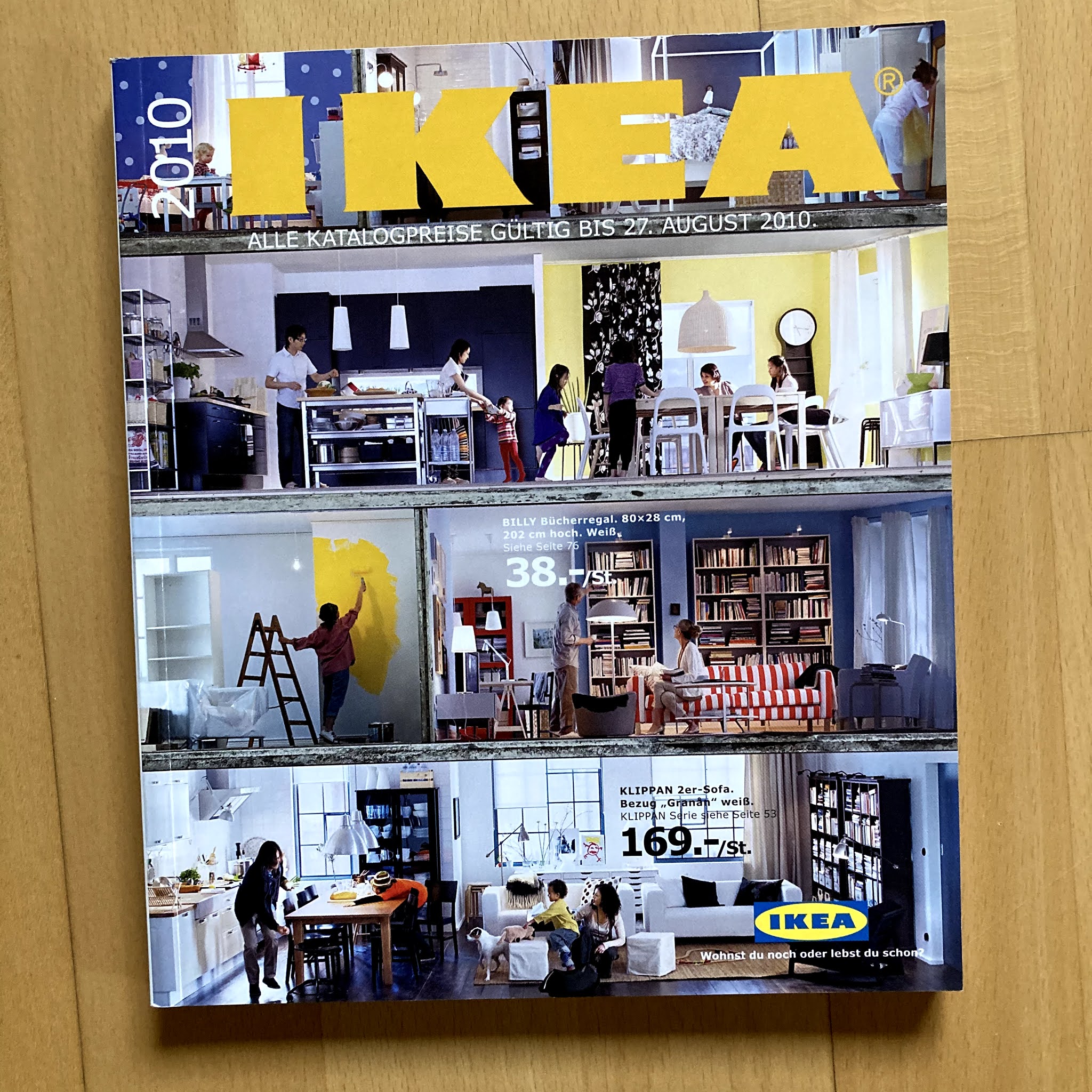
Last week, it was announced, amid much over-use of the word "iconic", that the IKEA Catalogue was going into retirement after 70 years' sterling service. I thought I'd take the opportunity to dig out my collection which probably isn't quite iconic, but does span four decades - and sits in an IKEA box upstairs in my IKEA-furnished office.
The first catalogue I have is from 1990:
This pre-dates my arrival in Germany, but I saw plenty of the black, deep blue and purple look for interiors in my first few years here. Check out this black leathery office:
The first catalogue that came legitimately into my postbox (I suspect I saved the 1990 deep blue horror from a clear-out at the IKEA offices at some point) was the 1997 edition - still in DM, note.
Bauhaus, eat your heart out! Moving into the 21st century, and the year we set up house - 2004:
I bought several items from this Kingdom of Children collection - note: no pink Princesses:
In 2010, the catalogue shrank a little in overall dimensions, but the cover took an expansive approach:
Which brings me to the latest example I have - behind the times as ever, I only have the 2020 edition, not the very last one:
I am sure there will be people who will be pleased to see the back of the IKEA catalogue. Well, here you are. Note the LACK table's decrease in price from 1997 (DM) to 2007 to 2010.
As they say in Sweden:
Hej då!