Showing posts with label beer. Show all posts

Friday, 11 April 2025

What a wonderful world


When I was writing my children’s books, there was a lot of blab about world-building. Fantasy author types would wax lyrical about the joys of creating mystical realms - with many of them getting a bigger kick out of this stuff than plot or character. I often found it all a bit much - reminiscent of the Dungeons & Dragons nerds I met at college. 

Nevertheless, I did get on and do it myself. The world of my stories is based on the real world in the late 1950s to mid-60s, then given a blast of kerosene in the form of action-spy-adventure films of the time. Maybe there is already a name for the genre - Jet Punk, or something. My publisher, Kay Green, described it thus:

There is a subtle magic here. The book matches the demands of modern 9-12s fiction and the main character is very much a 21st century boy but, without interrupting the action, the story speaks eloquently of a long-forgotten beauty – not fantasy, not ancient history, but something you and I had forgotten was magic: a Britain where country roads were bright and welcoming, where cars, motorbikes and aeroplanes – not to mention their pilots – still had an aura of adventure about them. And on top of all that, it’s laugh-aloud funny.

World-building is something that good planners and creatives have always done without thinking about it too much. (Or talking about "world-building”. Which always sounds a touch self-important and pompous to me.) But it seems to be something that’s being rediscovered - many of the trend reports have mentioned “brand lore” and a couple of weeks ago, I read this article from Tom Donohue of BeenThereDoneThat.

Warning: one or two phrases in here did make me squirm, but the point “You build the mythology, they tell the stories” is a good one. I’m not convinced that “we need new frameworks that break the rigidity of the brand key/onion”, though. I think it’s too many frameworks, tick-boxes and processes that have brought us to the sorry state that commercial creativity is in. Frankly, the fewer frameworks, flywheels, models, tools, templates, personas and CDJs I have to deal with, the better. 

To prove I’m not just being a dreadful curmudgeon, here are a few ad-type things I’ve seen recently that do portray a wonderful (and distinctive) world of the brand in question, capturing its soul or spirit (if you like).


Poretti Beer - I haven’t seen such a brilliant and distinctive campaign since many a year. Away with all the stock pictures of inanely-grinning young things! (Who’d probably turn their noses up at a nice beer if it was offered.) “Welcome to the Lake” - yes, please!

Funny that the next one’s alcohol, too. My old friend Jägermeister


Swag meets Stag. Like it - and the women’s sneakers are already sold out - I checked.

While we’re in Germany, have a look at Jack Wolfskin’s latest campaign. Which goes to show that you don’t need to invent a fantasy world for your brand - just explore the wild places of our own world ...

... you’ll see trees of green, red roses too ...


Thursday, 6 June 2024

RETROWURST: World Cup Beer June 2006


A bit of a funny this time - a World Cup with a difference ...

------------------------------------------------------

Well, it is certainly a funny old tournament with a few surprises so far. Whoever would have thought that Argentina, Brazil, Italy and Spain would get knocked out in the first round? Or that the Ivory Coast, Ghana and Tunisia would make it to the quarter finals?

Some results have been a bit more expected, with Saudi Arabia, Angola, Iran and Trinidad & Tobago making a rapid exit with no points scored, or France sneaking though to the semi-final. Or what about the England: Germany clash in the first round of the knock-out stages? Expected, perhaps, but for England to get through against such an overdose of German pride and tradition on their home ground? Commendable, but then the tragedy of being beaten by an unexpectedly strong Sweden in the quarter final…


The stars of the tournament, as expected perhaps, are the Czech Republic but the dark horse has really been Serbia and Montenegro who have knocked out Holland, Portugal, the Ivory Coast and those pesky Swedes on the way to their place in the final.


Well, you’ve twigged, haven’t you? I’m not talking about that World Cup. But can you guess on what basis this “alternative World Cup” is? It’s not too difficult: Germans as we know pride themselves on their beer and someone at Stern magazine had the bright idea of testing the beers of the 32 World Cup football finalists.


Despite some difficulties in securing products- with tales of bottles exploding en route and non-alcoholic beers being held up at the border for alcohol tax, beers were obtained for all 32 participating nations, except Togo, where the beer from the Ivory Coast went to test twice, once masquerading in a Togo shirt! The beers were tested blind by four Sternjournalists plus one beer expert from Austria (who apparently did the tasting in full Austrian traditional costume).


The beers that made it through the first round were:

GROUP A: Germany (Beck’s), Poland (Masuren)

GROUP B: Sweden (Old Gold), England (Old Speckled Hen)

GROUP C: Serbia & Montenegro (Jelen Pivo), Ivory Coast (Flag)

GROUP D: Mexico (Corona Extra), Portugal (Sagres)

GROUP E: Ghana (Akosombo), Czech Republic (Budweiser)

GROUP F: Japan (Asahi), Croatia (Karlovacko)

GROUP G: France (Kronenbourg 1664), Togo (Flag)

GROUP H: Ukraine (Obolon), Tunisia (Celtia)


The quarter finals were between England and Sweden, Serbia/Montenegro and Ivory Coast, Ghana and Czech Republic and France and Tunisia.


England got kicked out at this point, with semi-finals between Sweden and Serbia/Montenegro and Czech Republic and France, leaving this as a very European contest at this stage.


The final featured two teams from the former Eastern Europe, Czech Republic and Serbia/Montenegro. It was a close-cut thing, but the favourites won in the end with four points to Serbia/Montenegro’s three.


The comments that the judges made about the beers are interesting. The Argentinean beer, “Quilmes” was described as “like water with beer flavour” while the Iran beer, “Golden Delster” was described as “alcohol-free with milk sugar – and it stinks of old hay.” The English beer, “Old Speckled Hen” was described as “amber coloured, lovely note of hops, light toasted aroma” and England fans will be pleased to hear that this beer kicked out Beck’s (the beer, not the footballer) 5:2 at the quarter final stage.


Note, of course, that it was the original Czech Budvar Budweiser that won and not the pale US imitation. The USA, by the way, was represented by “Miller Genuine Draft” and failed to progress beyond the group stage.


On another note, the Germans were the masters of anti-hype about their team here in the build-up. The team that has now gained that so-familiar horrible unstoppable momentum of efficiency that always ends in tears at penalty shoot-outs were all-but-written-off at the start of the tournament (“we’ll be really pleased to get through the first round”) and Stern even published a consoling article for fans should the team make an early exit: Things Germany is World Champion of. Some of these are predictable: in export, in number of tax laws, in submarine construction – but did you know that the Germans are also World Champions in running backwards, donating to charity, robot football (well, perhaps we knew that…), spitting cherry stones or the quaintly-named Arschbomben-Springen der Damen (“Ladies’ Cannonball/Divebomb)?


It’s enough to make you reach for a Jelen Pivo!

------------------------------------------------------

I do wonder if this influenced me 14 years later, in the midsts of Covid, to hold an alternative Eurovision - with wine. And if I remember rightly - difficult in the circumstances - Italy won that one!

Friday, 22 March 2024

A drink in the Black Forest


I first travelled to the Black Forest around the time of this musical masterpiece (or at least, the Herb Alpert version). My parents bought me a little plastic cuckoo-clock-style house, which you could peer into and click a button for changing colourful landscapes - dark pine forests, snow and sky, sweeping lush pastures with perfectly positioned cows.

I didn’t return for more than two decades, which is when I most likely first encountered the wonderful Pils from Rothaus brewery - Tannenzäpfle. The pine-cone beer. The beer has been around longer than I have, and originally featured an illustration of a the typical Schwarzwaldmädel beloved in the wholesome Heimat films from the 1950s. These were a kind of escape into a world that never really was, an attempt to console the German population and blot out some of the stains of Nazism from the national psyche:


The label was redesigned in 1972, with a graphic version of the young lady - nicknamed “Biergit Kraft” by brand fans. I recall that this characteristic bottle was the beer available at the primary school’s “garden” at our local Hof und Gassenfest, along with Baden wines and Schwarzwald sausages, further imprinting the idyllic imagery in my mind. It’s a brand that’s a long way from edgy, gritty, urban pubs or laddish humour. In the past, sponsorships and a bit of outdoor aside, Tannenzäpfle hasn’t been a huge advertiser. But who needs to be, with a label like that?


But that’s all changed. The first big brand campaign for Tannenzäpfle has been developed by Kreuzbergkind (you can’t get less Schwarzwald, or more Berlin than that agency’s name!)

It’s all based around the idea of “Always calm.”


It’s a nice campaign - I like the calm pace, the slowing down, the serenity.

But I wonder: is it a little bit too goody-goody? Substitute other methods of crafting, and it could be for mineral water, or outdoor clothing or something like Bionade. It’s missing the quirkiness of “Biergit Kraft” and her pine cones. 

Pass me a another slice of Schwarzwälderkirschtorte while I consider.

Thursday, 19 October 2023

Love, peace, piss-ups and brass music


Ten years ago, if you’d told me the gin market would shortly explode and still be gaining sales in 2023, when young people are allegedly drinking less alcohol, my head would have been surprised. 

But not my heart. I’ve always loved gin and know that it's a damned good thing. It just needed the right time, the right conditions and some clever marketing to get it back in vogue.

I came across something that reminded me this a few weeks ago, on a late summer holiday to Baska, on the island of Krk in Croatia. Something I had always loved given a bit of reinvention, a bit of borrowing from popular culture - and being lapped up like crazy by people young enough to be my grandchildren.

The event in question was Brass Palmas . This is the beach party event associated with the Woodstock der Blasmusik  . The experience was quite surreal. At one end of the beach at Baska there’s a nudist resort.

At the other there are trumpets, tubas, trombones, saxophones.

Buckets of beer and cocktails.

Dirndls, Lederhosen and plenty of Skipton Alfie-style loud beach pyjamas.

Imagine the slightly staid world of oompah music given a large shot of festival/club/Ibiza atmosphere, and there you go.  The kind of mix that sounds ridiculous on paper, but just works in reality - and how!

There’s a party boat, a pool party, and non-stop music, dancing and drinking from stupid o’clock onwards.


And behind it all is some very neat marketing - brilliant brand name and logo ... and of course all the merchandise you could possibly want.


It’s a blast!

Friday, 23 September 2022

Local Yokel?


September is a time when I’m intensely aware of the local region I’ve landed up in here in Germany. Maybe it’s because we’re a bit out in the country, surrounded by orchards and Apfelwein presses, where mountains of local apples are delivered every morning, growers paid by the kg for their wares. There’s a Kurbisfest one Sunday in our town, with pumpkins of all shapes and sizes lined up ancient steps and round the well in the town square.

Germany has always been more intent on regional and seasonal produce than the UK. It could be that showing regional pride and loyalty is slightly more palatable for many Germans than nationalistic flag-waving. Or perhaps it’s simply because Germany is a far bigger, federal land, less centred than the UK on its capital.

The main supermarkets here have generally got their act together about regional produce. Given that the roots of these supermarkets were in local co-operatives, maybe it's no surprise. Incidentally, the word Kolonialwaren had always puzzled me - you can still see the word on old shop signs - it was used to describe imported goods such as coffee, tea and sugar as well as spices. 

Of the two biggest supermarkets, I’m more familiar with the No. 2, REWE, founded in 1927 and based in Köln. (No. 1 is Edeka - where the “k” comes from Kolonial - which was founded in 1907 and is now based in Hamburg.) REWE offers a wide regional selection of products, labelled up as so:


These products are mainly fruit and vegetables, eggs, dairy and meat products, but also honey, flour and wine. Local brands of, for example, jam or pickles may also be offered under the regional banner. 

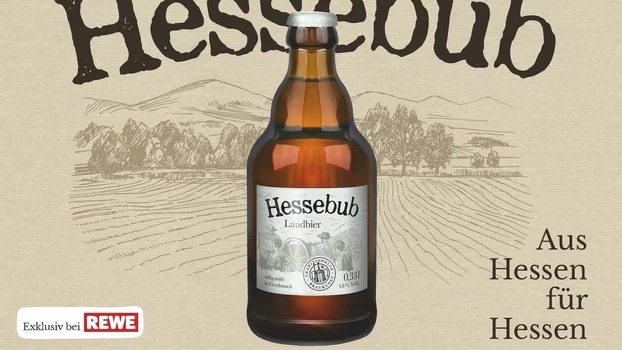
But this summer, I noticed a new development for REWE - a beer named Hessebub, which is roughly translated as “Hessen Lad”. The packaging looks very much as this could be a small local brewer who has been crafting beer for centuries that REWE have picked out of obscurity and given a helping hand.

But the reality is different: this is an Own Label masquerading as a brand. It’s an interesting one, a kind of manufactured authenticity. The beer is brewed in Darmstadt, so the product is as authentic as could be. But the name and label design were brewed up in a 21st century office. 

A genuine local brand, or the equivalent of a flashy advertising executive pulling on hired Lederhosen once a year for the Oktoberfest? 

Thursday, 14 April 2022

Parable


I am not normally a fan of “social experiment” ads. There was a nasty spate of them a few years ago - either manipulative codswallop by beauty brands for “poor me” narcissists. Or po-faced offerings from previously jolly beer brands jumping on the latest Twitter trend. Patronising, preachy and pretentious stuff, instead of being informative, entertaining or useful.

However, when we’re talking life or death rather than cans of cheap lager or mostly-water body lotions, maybe such ideas can make a point. 

“First Aid for Humanity” is an ad by VMLY&R Poland for the Polish Red Cross, supported by BNP Paribas. The idea was a first aid training course that used dummies that not only looked like real people, but were modelled based on real people who have faced discrimination. These were a homeless man, a Muslim woman refugee and a genderqueer activist. The participants in the course were encouraged to set any prejudices they may have had aside. At the end, they met the people behind the dummies in real life to hear their stories.

Have a look here.

I listened to a talk by Orlando Wood the other day, and he mentioned that advertising that gets noticed employs metaphor, connections and relationships and is in some ways like a parable - it’s not telling you what to think, but leaving you to process it and work that out for yourself.

And of course, “First Aid for Humanity” is a 21st-century retelling of one of the greatest parables of all time - The Good Samaritan (see Luke 10: 25 - 37), about the man who “fell among thieves” and was ignored and left for dead by both a priest and an assistant priest of his own religion before he was rescued and cared-for by a man of a different and opposing religion. 

“First Aid for Humanity” is an effective piece of communication, but I did wonder if it could be have been even more effective if the dummies had gone beyond the “acceptable” victims of discrimination. 

What if your neighbour is a skinhead football hooligan with a few dubious tattoos?  

Wednesday, 2 June 2021

RETROWURST: Das Pfand June 2003


Goodness me, I had a bee in my bonnet (or Coke can) back in 2003 about the farce of deposits on cans. In another of my Retrowurst articles salvaged from the mists of the past, I describe the situation regarding Das Pfand, or deposits on bottles and so on in Germany. Did this really happen, or did I imagine it?

------------------------------------

This month I’m going to be writing about something that started off with all good intentions here in Germany, but which has escalated beyond all reasonable proportions to become farcical - the Pfand.


My first (very positive) conscious experience of the all-pervading influence of the Pfand on daily life in Germany was on my first trip here in 1994. We were visiting Freiburg, a beautiful university town in the Black Forest. It was a warm evening in late May and we had climbed up a small hill to a beer garden overlooking the old town. In the beer garden were long wooden tables at which sat large numbers of people, mostly students, enjoying beer after beer without getting at all rowdy or out of order! It was all very civilized. It occurred to me that this was all very different to what I’d experienced in pubs outside in the summer in my student days where the over-riding memory was of lots of rather worse-for-wear people drinking lager out of plastic cups. And this was the big difference. The pfennig dropped. It was civilised because people were sitting down, drinking out of nice, solid beer glasses. ‘Don’t people ever start throwing the beer glasses around?’ I asked my friend. ‘Certainly not - they’d lose their Pfand’ was the answer. 


The Pfand is, of course, the deposit, that you pay on a glass when you drink outside, whether it’s at a fest or in a beer garden or on a nice pottery mug with Glühwein at the Christmas market. For a little bit of extra admin on the part of the serving staff, you get treated like an adult and enjoy the drink itself and the whole experience more - after all, everything tastes nasty out of a plastic cup. And it’s not just in bars and restaurants that one pays a Pfand, it’s also in the off-trade, which is the main subject of this piece.


The Germans have always been a step ahead when it comes to re-cycling compared to us Brits. That, coupled with their drinking habits, has meant that the whole way that one buys drinks for in-home consumption and the trade structure is a little different. Beer tends to be sold in re-usable bottles which one buys in crates, water is bought in re-usable glass (or increasingly PET) bottles, also by the crate and soft drinks are usually bought in re-usable PETs too. All of these bottles and crates have a Pfand on them and Germans tend to buy drinks on a separate shopping trip to the groceries from a separate Getränkemarkt, or drinks warehouse, which may be attached to a Supermarket chain but will invariably be in a different building.


This is all well and good for bulk buying for in-home consumption where it’s easy to pour yourself a glass of cola or open a bottle or two of beer then store the empties in the crate in the cellar to be taken back at a later date. However, where the Pfand idea is now getting out of hand is in the so-called Einweg sector of drinks cans and bottles - packaging forms that can probably be re-cycled but cannot be re-used. Typically, these tend to be the drinks that one buys for out-of-home consumption- the bottle of water for the train journey, the can of cola for lunch in the office and so on. Until the beginning of this year, one could buy drinks in these packaging forms without thinking.


The government in Germany is a red/green coalition and it was from this government that the thought came to put a Pfand on Einweg drinks in order to reduce the build-up of waste. Even though, many of the cans and plastic bottles can be re-cycled, this of course won’t happen unless people dispose of them in the right bin. So the solution was to put the responsibility for collecting these empty cans and bottles out of the hands of the consumer and into the hands of the retailer with the introduction of the Einweg Pfand. This where the whole story starts to get absurd. If you buy a can of cola from a shop, a kiosk or a sausage stand, you have to pay a deposit on the can and bring it back to the place that you bought it with the receipt as proof of purchase. Now, for a couple of Euro Cents, most of us wouldn’t bother. However, in some cases, the Pfand is not much less than the price of the drink- for example, a can of Pepsi in my local shop is 27 Euro Cents but then with 25 Euro Cents Pfand on top of this.


One does have to question, good intentions aside, whether all the extra hours involved on the part of the retailer for the admin involved and the extreme consumer annoyance is really worth the long-term environmental benefits. Canned drinks have almost disappeared from the shelves of the drinks markets as people are voting with their feet. The real issue is for manufacturers and the ever-expanding drinking-on-the-go segment. I know that my own response has been to buy drinks in tetrapacks or those foil pouches when I’m out and about and I know that many others do the same. Perhaps the real solution is for manufacturers, retailers and the government to work together to develop universal can-return stations where at least you can buy your can of drink at Frankfurt station and put it in a disposal unit in Düsseldorf station to get your money back. Unfortunately, this is something that should have been in place before the Pfand was introduced so that we wouldn’t have had to live through the chaos that now operates.


But at least, when you’re hot and sweaty from driving around to the six different places where you bought drinks last week to get your deposit back (and wasting God knows how much petrol in the process) you can sit down outside in a nice beer garden and enjoy a beer from a proper glass.


----------------------------------------------------------

Maybe it’s digitalisation, maybe I’ve adapted and simply become more German. But these days, you can return your cans any old where, more or less. I’m still quite smug about how Germany was always one step ahead in this area, ditto cloth shopping bags.

Maybe the moral is that some things have to get worse before they get better.

Tuesday, 2 February 2021

RETROWURST: Mixed Beers February 2004


A New Year, a new series on Extrawurst. Going back to my roots aka Wurzeln, if you like.

When I started freelancing, back in 2003, I decided to write an article each month on a market, brand or aspect of life in Germany. This was originally for my friends The Value Engineers.  Later, the collected articles found their way onto my (currently undergoing digital transformation) website. And in 2008, I started this here blog, and the articles grew sad and dusty on a long-forgotten external hard drive.

I reckon 15 years is long enough in the past to be retro, so, with a fanfare of red plastic trumpets, here comes Retrowurst. There'll be one of these a month, and I hope they will interest, intrigue and maybe give a nostalgic taste of the early days of this millennium, the days when I was still a relative stranger here.

From February 2004, here's a piece on 'Mixed Beers.'

Cheers!

--------------------------------------------------------------------

This month, I am going to consider a few developments in the German drinks market that would have Wilhelm IV, Herzog of Bayern, turning in his grave (and which would have probably turned his stomach too, had he still been alive)!


Wilhelm IV of Bayern was responsible for passing the world’s oldest law concerning foodstuffs, otherwise known as the Reinheitsgebot or Purity LawIt is not known whether the duke of Bavaria passed the law as a result of a terrible hangover or stomach upset, but he decreed, on 23rd April 1516, that beer produced and sold in the towns, markets and countryside of Bavaria should contain no ingredients other than barley, hops and water. For hundreds of years brewers in Bavaria and later in the rest of Germany obediently followed the Reinheitsgebot and Germans enjoyed the benefit of what is arguably the best beer in the world. The German beer market has not been so influenced by the fads and fashions seen in the UK, for example. Of course, the odd imported beer can be seen now and again in the more fashionable bars and clubs but, by and large, most Germans are happy with a glass of Pilsner or one of the more localised beer variants. Whether it’s a bottle at home in front of the TV for Sportsschau (no self-respecting German would dream of drinking a can of beer) or a half-litre sitting in the Biergarten in the shade of chestnut trees in summer, it tastes good every time and generally has no undesirable or anti-social after-effects.


However, one thing that Wilhelm IV did not forbid in his Reinheitsgebot was the mixing of beer with other drinks. And it is in this area that the worrying developments are now taking place. There is a fairly long tradition of beer-based mixed drinks in Germany. What we would term shandy – beer mixed with lemonade – is known here as RadlerRadlerliterally means ‘cyclist’ and this drink was traditionally offered as a thirst-quencher to cyclists in the summer as an alternative to drinking large quantities of potent beer. Jerome K. Jerome’s book, “Three men on the Bummel”, a sequel to “Three men in a boat” paints an evocative picture of a cycling tour through the Black Forest in the early years of the 20th Century where Radler is, naturally, consumed.


Another more recent beer-mix drink is Colabier, which is particularly popular amongst young people. Colabier is also known as Dreckigesbier or ‘dirty beer’ on account of its somewhat off-putting appearance. Despite being an odd concept and looking pretty revolting, Colabier is actually quite palatable in the right context. It is a good party drink, as the caffeine kick counterbalances the soporific effect of the beer.


As they stand, Radler and Colabier seem harmless and non-threatening enough to the mighty German beer industry, with their connotations of idyllic Edwardian summers and youth club barbeques. But the beer industry here is not as healthy as it was. Although the Germans are still high up there in the beer consumption league (second only to the Czechs), beer consumption per head is down. In 1995 consumption was 136l per head per year; by 1999, this was 127l per head. Although this is still equivalent to 0.33l per person per day, the trend is at best static and at worse, in decline.


Increasing concerns with fitness and health have resulted in less alcohol consumption generally and young people are beginning to look to other drinks.


Alcopops and ready-mixed drinks hit Germany a little later than the UK but have become very popular in the last couple of years. The focus is more on the ready-mixed drinks, such as Smirnoff Ice or Bacardi Breezer, or bottled versions of cocktails such as Mojitos rather than alcopops. The breweries have responded by producing commercial, ready-mixed versions of beer-mix drinks with a difference. While ready-mixed Radler has always been available, this was normally promoted at a very low level with nostalgic graphics and imagery, which could have come straight out of Jerome K. Jerome.


The new beer-mix drinks are aggressively promoted and clearly targeted at the young club and party crowd with funky or hi-tech names, graphics and ingredients. Most of the major breweries are getting in on the act, with an ‘if you can’t beat them then join them’ mentality. Licher, a medium-sized regional brewery from Hesse, which promotes its main beer brand on a very ‘nature-influenced’ platform, has introduced ‘Radler Limone’, ‘Cola 2’ and ‘Fresh Lemon’, with modern graphics and pack design. Diebels’ Cola Mix is called ‘Dimix’ with hi-tech graphics, while Köstritzer has a sub-brand called ‘bibop’ described as ‘dark beer with cola and guarana’. One of the biggest breweries, Krombacher, has a sub-brand called ‘Cab’ which is ‘Cola and beer flavoured with dragonfruit’. The pack design has a far-eastern touch, with no reference anywhere to the Krombacher or German heritage.


It will be interesting in the long run to see what effect these developments will have on the German beer industry. Will these commercially produced and over-marketed mixes pollute the good name of German beer? Or will they introduce young people to the world of good quality beer? Without being too pessimistic, these sub-brands have a distinctly ‘mutton dressed as lamb’ or ‘embarrassing Dad at school disco’ feel about them and one can’t help wondering if there are more appropriate and effective ways for the German brewing industry to revive its flagging fortunes, maybe by going back to its roots – all the all way to 1516 and Wilhelm IV, in fact.

-------------------------------------------------------------------------


Well, as always happens, the answer isn't either/or - it's both. And neither. Beer consumption has continued to decline in Germany (from 115.3l per head in 2005 down to 99.7l per head in 2019), while Germany now appears to have slipped down to the 4th in the world in terms of consumption - yes, the Czechs are still up at the top, but both the Namibians and Austrians have slunk in between, according to one data source.

The wild and wonderful flavours have continued to proliferate, including some unholy mixtures involving energy drinks. But - the trends to local and regional, sustainability and craft beer have meant that even though Germans are drinking a little less, there's more choice on offer than ever. 

Thursday, 27 August 2020

Data, information, knowledge and wisdom


Photo by Martin Schitto, July 2020

Would I rather be knowledgable or wise? Can you be one without being the other?

I see a kind of progression, according to synthesis level, from data to information to knowledge to wisdom.

In a preamble to one of their articles The School of Life picked up the distinction between knowledge and wisdom, suggesting that knowledge is the accumulation of facts, figures and theories, while wisdom is the further synthesis of this knowledge with experience.

Knowledge can be forgotten, while wisdom can't.

Knowledge is specific to subject and context, while wisdom is universal and timeless. 

Regarding the latter point, many moons ago, I did my A-levels following my Cambridge Entrance Exams (this was a bit topsy-turvy, but that's always been my way). I had to swot much more for the A-Levels than the Cambridge Entrance Exam as these were more about regurgitating my knowledge - the structure of DNA and how it all worked, for example. For the Cambridge Entrance Exam in Biology, you'd get asked something like "What is the importance of water to life."

I've written a post or two about A.I, and I fancy that a machine these days may have fared better in my Biology A-Level than I did. I don't discount the idea that a machine could be described as "knowledgeable" - why not, if we already describe machines as "intelligent"?

But I doubt that we'll ever have a machine that is wise in the way that a human being is.

I'd welcome a change from thinking about "data-driven insights" to "the wisdom of insight".

The rather pensive photo of me in my cellar pub had me philosophising, about the Road to Excess and all that stuff.

I know I'm doing something wrong as I don't seem to have cracked the "wealthy" bit of the healthy, wealthy and wise thing, although I'm not sure wisdom brings wealth these days.

Maybe it's a case of "Late to bed and late to rise makes a (wo)man happy, healthy-ish and wise"?

Monday, 29 April 2019

Accentuate the negative?


I've always found going into a T K Maxx store rather like stepping into a Baz Luhrmann musical. You're not quite sure what will happen, but it will certainly be vibrant and colourful and over-the-top. The latest ad in a series of quirky films for the store uses the creative ploy of turning doubts into full-blown dance-til-you-drop "definite dos."

It's an off-the-peg creative strategy, to turn potential negatives into unique positives for the brand, but the execution is definitely made-to-measure for T K Maxx. It's completely in brand character, and there's never the risk of the brand taking itself too seriously.

Which brings me to my second exhibit. Carlsberg. The Orson Wells voiceover "Probably the best lager in the world" signed-off one of the classic campaigns of the 70s, 80s and beyond. That "probably" was a word that said 10,000 other words - understatement, wry humour, self-deprecating amongst them.

But what have the Carlsberg marketers and their agency partners done now? Taken a classic advertising line at face-value, re-brewed and redesigned their product and all that goes with it and "launched its most ambitious and honest consumer facing campaign ever." The line is now:

Probably not the best beer in the world. So we've changed it.

This article by David Mitchell sums up much of what feels simply not right about this approach. As he says, "Probably the best lager in the world didn't feel like a serious claim - it just made you fond of the brand because it was humorous."

Fond of the brand - that's what marketers want, isn't it? Instead of the understatement and wry humour, will all the hand-wringing and hair shirts and po-faced blah-blah about honesty and higher purpose really lead to people having a little place for the brand in their heart, at least now and then?

Probably not.


Friday, 12 April 2019

Cheers to Purpose!

Like Brexit, the debate on the subject of Purpose seems to be on an ever-loudening crescendo. Sticking the word "Purpose" into the headline of an article that's about something completely different is guaranteed clickbait for the marketing community, in the way that "digital" was a decade ago.

And, like Brexit, both sides - as this is what it has become - are capable of persuasive argument and rhetoric.

My own view is that, in many of these articles, the language is wrong. The use of the words "higher" and "beyond" and "above" suggests a judgement that purpose is noble and profit is dirty.
Whereas surely they should work symbiotically?

A brand does something positive for the individual user. This can be practical, cognitive, sensory, emotional, or some combination. Some used to call this the benefit.

And that brand - or business - does something positive on the collective level - for the family, community, society or the world. For many brands and companies, this was always so, but maybe not vocalised. Changes in the world, in society, and in technology mean that this collective positive contribution - purpose, if you like - is becoming an imperative, rather than a nice to have.

It doesn't have to be about the UN sustainable goals. It doesn't have to be a "cause." It doesn't even have to be totally exclusive to your brand or company, as long as you do it in your own distinct way. But I believe it does have to relate back to the product or service your brand offers, and what it does for the individual.

A good example, for me, is what the brand Carling have done in the UK. 3 pubs a day there close their doors for good, and with the high level of Beer Duty in the UK, that will continue or worsen.  A movement has started via Britain's Beer Alliance to celebrate the positive role that Britain's pubs play in individual lives and communities: Long Live the Local

As part of the movement, Carling have produced a music video with the band Slaves, who started in pubs, which looks at the role pubs - and beer - play in music and creativity as well as community. It's not high and mighty, yet reflects brand belief and values, moving from the individual to the community.

Mine's a pint, thanks.


Friday, 21 December 2018

The original pop-up stores

On a wet and windy weekend, the traditional Christmas Markets are selling off the last of the Glühwein and Lebküchen, and will be packing up on Sunday. Christmas Markets - like all markets really - are the original pop-up stores. There's still a good representation of craftspeople selling everything from knitted socks to wooden spoons to cookie-cutters in every shape and form imaginable, as well as Christmas decorations ranging from tacky to terrific.


But increasingly, the Christmas Markets are becoming more about the food, drink and "gastronomic experience" (or whatever we're meant to call it these days).  There's a growing tendency for places to sit indoors within the Christmas market, to guzzle your Glühwein in comfort.

And it was only a matter of time before brands would see the opportunity. At the Köln Heumarkt Christmas Market, you can enjoy a beer or two in the Allgäuer Büble Alpe - a beautifully constructed rustic barn with the feel of an Alpine hut.
Allgäuer Büble Bier is the sponsor of the Christmas Market, and the whole barn is splendid to behold, quite in keeping with the feel and tradition. But I rather hope that there won't be too much branding invading this brand-free zone in the future, particularly if some of the global food and drink brands try to get in on the act.

Meanwhile, have a wonderful Christmas and don't drink too much beer, Glühwein or anything else in case you too start to see ski-ing gnomes!

Sunday, 3 June 2018

Purpose Parody


As someone who has worked in advertising for more years than I'd like to admit to, the thought that often provided me with the best guidance is: "it's only advertising." Perhaps that hides a regret that I never became a brain surgeon, or something equally useful, but it has certainly saved my sanity more than once.

When I worked in the UK, I admired the way that the ad industry constantly took the mick out of itself, from ridiculing preposterous product demos to beer brands sending up pompous and pretentious perfume ads.

I've commented before that the industry seems to have lost its sense of humour of late, and it seems ironic that it's a beer brand that's being parodied in the video from Oasis (owned by Coca Cola) above. The Togetherness Bottle campaign, created by The Corner, London, has a subversive swipe at all those worthy ads with their plinky piano music and social experiments: "Brands acting holier than thou while everyone knows it's about sales, not saintliness," as its creators say. It's all part of an overall marketing strategy from Oasis, #RefreshingStuff, that the brand has been pursuing since 2015.

It's a fun idea with a serious point behind it for all marketers. Purpose is important for brands, but it really doesn't need to be about stopping wars, obliterating sexism/racism/anyotherism, empowering women, one of the United Nations Sustainable Development Goals or saving the world in any other way.

It could just be about refreshing people with a cooling fruity drink and a bit of a laugh when advertising people get too up their own bottoms.


Wednesday, 28 March 2018

Meanwhile, down at the Old Bull & Bush ...

I've had the pleasure of working on several alcohol brands throughout my career - Courvoisier, Harvey's sherries, and Lanson champagne, to name a few. The 80s and 90s of the last century were something of a golden age for drinks advertising in the UK. Who could forget this glorious commercial?


Working on alcohol brands today is a different story. Much of the brands' budgets are taken up with promoting what's called 'responsible drinking' which must be something of a conundrum. How do you promote your brand, differentiate it but at the same time warn about not going overboard with the stuff? It's a bit devil you do, devil you don't, and I don't envy people working with this puzzle, to be honest.

If you look at the stats and that alarming rise in the early 2000s, you can see why something had to be done:


And this is what you end up with. It kind of swims or sinks depending on how much cred the artist in question has. And I must admit that I don't have a clue on that front.


There was another time in history when alcohol consumption was at alarming levels in the UK - and by all accounts easily available to children:


At the end of the 19th century and beginning of the 20th, alcohol consumption levels were even higher than 100 years later. This gave rise to movements promoting 'abstinence' and 'temperance' rather than today's phrase 'responsible drinking.' These movements were usually linked to religions and certainly not to the alcohol producers themselves.

One such was the 'Band of Hope Union' which tried to nip the habit right in the bud. This was a club for children with the aim of preventing them from starting to drink alcohol. One method was to teach youngsters about the effects of alcohol on the human body, and certificates were awarded for 'reporting a lecture on alcohol and the human body' - the one above was awarded to my grandfather while he was in his early teens.

I know my grandfather grew up to enjoy a pint or two as much as the next man, but I wonder how much of the decrease in consumption seen in the pre-WW1 years above was due to the efforts of the Temperance Societies? Behind all the drum-beating and holier-than-thou stuff, they were at least treating teens as intelligent humans with an interest in the latest scientific findings.

Today, the UK alcohol industry is quite different to the one I knew 20 years ago. There are 10,500 less pubs in the UK today than there were in the year 2000.  Here's a recent article with this and other statistics on the Brits and drinking.

I'll end, I think, with a quotation from Hilaire Belloc which makes me slightly misty-eyed:

But when you have lost your Inns, drown your empty selves, for you will have lost the last of England.

Friday, 8 September 2017

Local Beer-o

We live in Hessen, but not far at all from the border with Bavarian - a matter of about 10km, I think. But this is not deepest Bavaria as in absolutely everyone in lederhosen and hats with shaving brushes attached, but rather what is known as Franconia or Frankenland. It's that part of Germany which lies neatly on the beer/wine border on the above map, and it happens that our near neighbours are rather good at both. The map, incidentally, is one of 18 stereotypical maps of Europe from Spain-based Bulgarian Yanko Tsvetkov. Well worth a look, but please don't take them too seriously!

One brand that seems to have been omnipresent in our lives this summer is Schlappeseppel beer:


Maybe it's because my son is now also legally allowed to drink (is Germany the only country in the world where you're allowed to buy alcohol at 16?) so the house is full of crates of the stuff, or maybe because every village Fest we've attended seems to be sporting sunshades/umbrellas from the beer brand.

Schlappeseppel is a great name to pronounce even if you have had a few, and is another beer brand that features what appears to be a child on its logo, which all adds to the charm. It originated in the Lower Franconian capital of Aschaffenburg amidst a story involving the 30 Years' War, the King of Sweden and a lame soldier named Joseph, which is where the name hails from, if all the hokum can be  believed.

I believe that the brand's success has to do with its unashamed appeal to authenticity, roots and tradition while being promoted in a 21st century way. The slogan translates to 'on/in everyone's lips for hundreds of years' and the website offers all manner of amusing gifts from felt slippers to Skat cards.

Mine's a large one, please!


Thursday, 2 February 2017

Political Shandy?

I must admit to having felt slightly queasy about the Budweiser 'patriotic rebrand' this summer, whereby the 'great American lager' was packaged in a new design where 'US' replaced 'AB' and 'America' replaced the brand name, along with the slogan 'America is in your hands.' Odd, really, as I have no qualms about brands from the UK getting all patriotic now and again .

Maybe the difference lies with the tonality: the British way is almost always tongue-in-cheek and rather self-deprecating whereas the Budweiser packaging seemed bombastic and taking itself far too seriously. I wasn't the only one, however: plenty of liberal-minded commentators found the Trump-style rebrand a little hard to swallow.

Budweiser is now coming in for criticism for its Super Bowl commercial: Born the Hard Way, which follows what I expect is a new advertising trope for 'story of our founder starring a moody and hunky young actor' - see Burberry.

Born the Hard Way tells the story of the founder of Anheuser-Busch, the brewers of Budweiser. Adolphus Busch was born just down the road from us, funnily enough, in Mainz-Kastel. He emigrated to St. Louis in 1857, at the age of 18, and the rest is history.

The film emphasises the difficulties faced by immigrants, and the hard work put in by Busch to found and develop what has become 'the great American lager.'


So now the criticism is coming in from the other side: the Trump supporters who see this as blatant anti-Trump propaganda.

I'm not too convinced that politics and beer is a good mix, but I wouldn't be surprised if we see a few more of these 'founder stories' doing the rounds.

Levis would seem to be a prime candidate.


Monday, 3 October 2016

Quite a Character


In previous posts, I've mentioned one or two of my favourite brand characters, such as the Michelin Man, and Mr Peanut, the Planter's character. Brand mascots or characters enjoyed quite a vogue in the first two thirds of the last century. And you can see why - a well-chosen character could encapsulate your brand values in a highly memorable and flexible form. The character could appear on the packaging, on billboards and metal signs, on promotional giveaways, on the radio and TV - and even make real life appearances.

Of course, the danger with brand characters is that they may become irrelevant, or even objectionable, as has happened with this little fellow:


In today's world, you would not assign your character a specific religion, as is the case with this chap:


Or associate him with a politically-incorrect sport:
Human and humanoid characters invariably become in need of a fashion update - at least according to the latest brand manager - although one may look back at 80s hairstyles and wish you'd left the characters in the timeless past somewhere.


Sometimes, the idea of the character survives, while the actual physical form becomes more symbolic, as has happened with Johnnie Walker's Walking Man (who I used to confuse with Force Flakes' Sunny Jim as a child. Luckily I didn't confuse the products!)

In the last few months, two characters who first appeared in the 1950s have had a revamp. KFC (founded in 1952 by Colonel Harland Sanders) has announced a rehaul of the brand under the banner 'Re-Colonelization.' It's a kind of back to the roots re-invention, with a push for quality and attention to detail: "The Hard Way") as well as various actors and comedians personifying the Colonel himself.

And another brand icon who hails from 1952 has been imbued with 'animatronic swagger', whatever that may be. Kellogg's Tony the Tiger is motivating tweenage kids to 'Let your Gr-r-reat Out' and think/act 'Like a Tiger.' As well as bearing some relation to what Nike and Always are doing, this was, of course a motivational technique deployed by Henry V, if Shakespeare is to be believed. Nice film, good sentiment, but not terrrrrrrribly original, I fear.


You can understand what these brands are trying to do. Decades-old brand characters do carry a potential richness of goodwill and positive association which it would be careless to lose.

Newer brands don't have this opportunity. The vogue for brand characters dwindled in the later years of the last century. In some ways it was 'Digital and Global killed the Brand Character'. Trying to create a new character who is understandable and acceptable to all, yet represents the brand's uniqueness, is not so easy these days. We have to think too much: just look at some of the truly dreadful creatures that have been spawned as mascots for the Olympic Games, or the World Cup, in recent years and you'll see what I mean.

But maybe, with the rise of grass roots local brands, the whole thing will go full circle again. Generally animals seem a better bet than human/oids as they don't need updating. I'll leave you with another of my all-time favourite brand mascots: Nipper.


Monday, 2 November 2015

Memory lane

The Autumn school holidays took us to the UK and the inevitable trip up to London. On something of a whim, I dragged my family off to Charlotte St to see if tales of the demise of the Saatchi building were exaggerated. Thankfully, I was able to take one last look at the place where I started my advertising career, back in the 80s.

And, not too far away from 80, Charlotte St, I spotted two newish brands that I'd loved to have worked on back then (and wouldn't say no now.)

In the Carpenters' Arms, our old watering hole, I was delighted to see that Madness have started brewing beer. While other rock stars may favour giving their names to wine or Bourbon, I think the nutty boys have a brilliant fit, branding-wise, with pubs and pies and pints. The section of the website dedicated to The Madness Brewing Company ('Beers that go one step beyond with flavour and style') presents the wares - Lovestruck Ale, Gladness Lager and Night Boat Porter. I had a quick half of Lovestruck, which was tasty indeed. Good one, chaps.

And a bit further down Charlotte St, I saw an idea that I wish I'd had. Well, actually, I have had this idea, only someone else has been much quicker off the mark. Herman ze German is a German fast food cafe selling sausages 'made in the Black Forest' by Fritz. Clever idea, great branding.
And, how could I resist their slogan?

'Our Wurst is ze Best.'

Saturday, 3 January 2015

Alcohol is not the solution. Or is it?

Did you have a few drinks too many on New Year's Eve? Was one of your resolutions to give up the booze, or at least have a dry January? If so, you may just find your creative problem-solving ability diminished.

Thinking back to my early days in advertising, there were a lot of long and liquid lunches which inevitably spawned some pretty damn good ideas, creative and strategic. Certainly, it seemed a more effective method than locking everyone in a "workshop" to drown in Post-It notes.

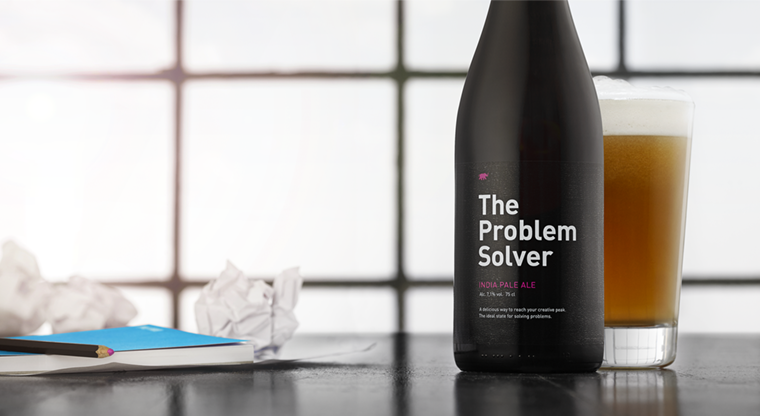
I'm now quite amused to see a new product which, on the basis of "scientific research", enables you to get to the optimum alcohol level for creative problem-solving: The Problem Solver Beer. 'A delicious way to reach your creative peak'.

Apparently, creative thinking peaks at a level of 0.075 percent alcohol, which is achieved through drinking half the bottle if you're a slim woman, or the whole lot if you are a relatively chunky man. There's a useful scale on the bottle calibrated to indicate your intake for optimum creativity. 'All you have to do is drink and think.'

Professor Jennifer Wiley on the University of Illinois at Chicago is quoted on the brand's website, saying that - amazing, this -  alcohol may help by making people less focussed which can open their minds to new and novel possibilities.

Well, I never!

I think I prefer red wine, though.

Cheers, and here's to plenty of creative problem solving in 2015!