News came of the death of Dietrich Mateschitz this weekend, the richest man in Austria, with an estimated fortune of $20 billion, the energy behind the brand Red Bull. I have long been an admirer of the brand , which couldn’t be clearer about what it is and what it stands for. If anyone wants an example of boldness in brand form, this is it.
Although Mateschitz didn’t do anything by the textbook, Red Bull is a textbook example of the difference between a product and a brand - an example of how an entire brand empire has been built around a single product that Red Bull don’t actually produce themselves. That empire extends from the energy drinks to motorsports, extreme sports of all sorts, football, media, hotels, music and goodness knows what else.
The brand is a powerful concoction of conviction, consistency and unconventionality. Very little seems to have been developed through workshops and market research, needs analyses, consideration of consumer journeys and pain points, competitive analyses and concept testing. As far as I know.
It’s a bit early in the morning for a Flying Hirsch, but then again ...
Among the many newsletters I subscribe to, those from The School of Lifeare less likely to be binned straight away than almost any other. (The most likely to be binned, by the way, are those that appear at the weekend, despite multiple attempts to unsubscribe).
What do I like about The School of Life? Well, I think it’s the tonality and attitude of the articles - calming, reassuring and wise. Universal, the opposite of throwaway. A recent article alerted me to the subtle difference between self-acceptance and self-love. Others talk about the value of melancholy, or failure, or other contributions to the human condition. It’s all so much more insightful than all that “being your best self” blah. I’ve always wondered - “best” in whose judgement?
However, what I encountered on my last visit to The School of Life was a rather unseemly mismatch between the tone of the articles and the website itself.
Hardly had I got into the site when a box popped up and more-or-less grabbed my wallet:
Not so much self-hatred as a disregard for the reader as a human being in favour of a nice source of income.
It got worse. The money-grabber was quickly pushed out of the way by the stalker:
“No” is the answer. It irritates me that many in the Anglo-Saxon world seem to think Berlin is the be-all and end-all of Germany.
And to complete the mismatching tonality, the “feedback” for a site that is all about the depth and complexity of human emotion is reduced to a few silly emojis:
I’m not a huge fan of Brand Books the size of War and Peace that give strict instructions about style and tone, but surely an organisation like The School of Life could use their insight and understanding so that their content and design isn’t quite such a case of chalk and cheese?
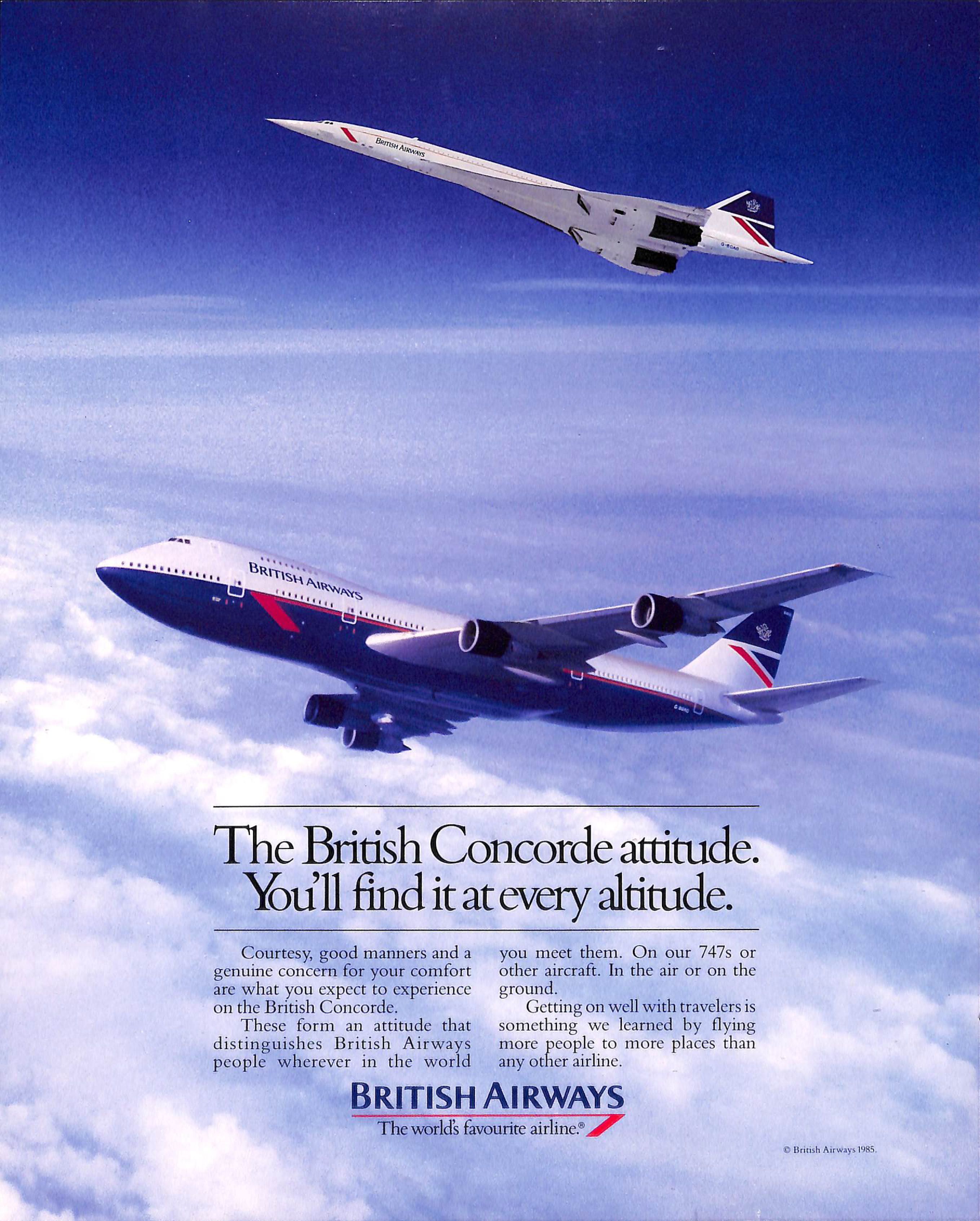
Back in the last century, when such things were aspirational and fashionable, I was a high-flying young advertising executive. I have undoubtably been in the British Airways Executive Club more years than those runningit have been alive, and made it to the dizzy heights of Gold Card Level.
Things have changed, to state the obvious, but I still hang on in there in the club, clutching my meagre points in the hope of having a “free” glass of fizz next time I fly to the U.K. However, given the grim news on cancellations and airport chaos, I’m not sure I risk booking a flight, let alone one with BA.
What are my Executive Club friends doing, meanwhile? Sending out cheery newsletters. OK, we all need cheering up, and they must have enough data collected on me by now to be able to make some reasonable guesses about what kind of content might be the most cheering.
A recent newsletter offered me “inspirational stories from LGBTQ+ writers and explorers” as well as “luxurious and remote desert hotels.” I was invited to “take a peek at family-friendly pads” and to do the “which cabin bag is right for you” quiz and fill it with “this season’s must-have travel essentials.”
The ghastly, cliche-ridden trash journalism style is bad enough (written by AI?) but as for an attempt at empathy or customer-centricity or whatever marketers are meant to be good at? It sounds as if they are writing for a not-so-bright 12-year-old with stinking rich parents. Which I’m not.
Equally dreadful is a recent email from P&O Ferries who say: “We’d love to still be your preferred ferry operator for your next trip, and are truly passionate about showing you all that travelling by sea has to offer on board our ships.” Like heck you are. Why would I be enanmoured of a ferry operator that sacks hundreds of its staff without consultation, then replaces them with desperate people paid peanuts?
I don’t want to take transparency to extremes and know every last little detail of corporate comings and goings, but surely people can be treated like adults?
I breathed a sigh of relief when I got this from Lufthansa’s Executive Board. By no means perfect (these things never can be) but at least they are talking the right language:
Dear Ms. Imgrund,
Two tough years of perceived and actual grounding lie behind us in aviation. All our Lufthansa Group employees have been wishing for nothing more throughout than to finally be able to welcome you back aboard our more than 750 aircraft.
Unfortunately, however, as the Northern Hemisphere summer begins and with global travel restrictions now almost all lifted, everyone involved in aviation worldwide is reaching almost daily the limits of the resources that are currently available. And the ramp-up of the complex air transport system from almost zero to now almost 90 per cent is clearly not proceeding with the reliability, the robustness and the punctuality that we would like to offer you again.
We can only apologize to you for this. And we want to be completely honest: In the coming weeks, as passenger numbers continue to rise, be it for leisure or business travel, the situation is unlikely to improve in the short term. Too many employees and resources are still unavailable, not only at our infrastructure partners but in some of our own areas, too. Almost every company in our industry is currently recruiting new personnel, with several thousand planned in Europe alone. However, this increase in capacity will only have its desired stabilizing effect by the time winter comes.
In addition, the ongoing war in Ukraine is severely restricting available airspace in Europe. This is leading to massive bottlenecks in the skies and thus, unfortunately, to further flight delays.
In the summer of 2023, we not only expect to have a much more reliable air transport system worldwide. We will be welcoming you back on board our Airbus A380s, too. We decided today to put the A380, which continues to enjoy great popularity, back into service at Lufthansa in summer 2023. In addition to this, we are further strengthening and modernizing our fleets with some 50 new Airbus A350, Boeing 787 and Boeing 777-9 long-haul aircraft and more than 60 new Airbus A320/321s in the next three years alone.
We promise you that our more than 100,000 Lufthansa Group employees will be doing everything humanly possible to provide you with the best possible air travel experience in the coming weeks, even under the current difficult circumstances. And they will be doing all this with a commitment that deserves the highest respect, not only from us on our Group Executive Board.
So on behalf of all our employees, I sincerely hope that you feel very welcome on board after your return, which is something we have all been keenly awaiting. We thank you for your loyalty; and we hope we may count on your understanding, too, should your journey not yet go quite as expected or planned.
We are doing our utmost to again offer you the quality, the punctuality and the reliability that you can rightly expect from your Lufthansa Group airlines as soon as we possibly can.
In this post from five years ago, I bemoaned the homogenisation of logos, films, language, pretty much everything, in an increasingly formulaic “smoothie society”. So it’s a little ironic that a brand that's ruffling a few feathers at the moment with its tone of voice just happens to be the original German smoothie brand and market leader - True Fruits.
The current hoohah is between True Fruits and supermarket Edeka. True Fruits had the bright idea, with the election coming up, of a topical brand campaign entitled Die Qual der Wahl (“The agony of choice” or thereabouts). Smoothie bottles are decorated with the names of the six biggest parties in the Bundestag with nine points from the party manifesto printed on the bottles - but two of these aren’t genuine. Can you guess which?
This alone would probably not have caused too mainly raised eyebrows had the company not decided to actually produce the bottles and deliver them to supermarkets. Edeka, for one, were unamused at the idea of displaying an AfD bottle on their shelves, so sent these back. A lively discussion has ensued between the two brands: what is democracy? Is information more important than virtue signalling?
True Fruits was Germany’s first smoothie brand, founded in 2006 by three student friends from Bonn. From the outset, they never wanted to ape Innocent with its goody-goody image and rather twee brand voice, or try and push out-and-out healthiness. So instead they have always emphasised their quality credentials, combined with a provocative tonality in their communication, more reminiscent of Oatly or BrewDog.
In the last few years, brand communication has sailed fairly close to the wind, with smutty humour eliciting complaints of sexism as well as making light of racism (“Our token Black”). Much of this is below the radar (as is the current debate) of those outside the ad/marketing community, and the brand continues to enjoy moderate growth.
What’s interesting is that True Fruit’s brand communication is done in-house - they don’t have an ad or PR agency. This is similar to the Oatly model. In-house communication and agencies used to be rather sneered at by creative agencies - typically it would be something like a Korean car brand who’d take this approach.
But these days the tables are turned. Now it’s the in-house communication that’s often more edgy, more provocative, braver - and more distinctive. The big agencies have had their wings clipped in the interests of diversity, inclusivity and equality - or someone’s interpretation of what those values imply. It’s unlikely that we’ll be seeing the likes of this again:
Back at the turn of the Millennium, it was called “cocooning”, a retreat from the 24/7 always-on world. It took on a Sacndinavian flavour in the last decade or so, in the form of hygge or mysig, with Instagram as a perfect medium to sing its praises. And it has been the over-riding trend and desire throughout the pandemic - and quite possibly something some people will be reluctant to move away from as the outside world re-opens. Indeed, it wouldn’t surprise me at all if workplaces become more homely once the workers return. Like kindergartens that allow children to bring one special soft toy or security blanket. When it eventually comes to Covid nostalgia - which it surely will - this word, this concept, will be top of many people’s lists.
I’m talking about cosiness. You can see its takeover of our world across fashion, across home furnishings and across books, to name just a few. The “cosy mystery” genre of the fiction section - those stories involving amateur sleuths in a picturesque community, with very little blood and gore to be seen - is selling like hot-cakes. Along with cuddly blankets decorated with pizza patterns.
Cats, crosswords, cakes, Christmas, crochet, cottages and countryside - all cosiness.
Cosiness is different to comfort. It is, if you like, a combination of comfort and joy as the song goes. While comfort is often sought to right a wrong, or can simply be the absence of unpleasant feelings, cosiness is a positive choice.
Cosiness is about free will, not a reaction to being victimised in some way.
Cosiness is very much about the senses, especially the sense of touch.
Despite the ubiquity of cosiness around us, there are very few brands that expound cosiness as a value. Maybe it’s because of the ubiquity, maybe because marketing people feel cosiness is too fluffy, not dynamic enough, not lofty enough.
But I think it would be a welcome alternative to all those rather high-powered brand purposes, tiring-sounding manifestoes, and being preached to.
I've always been a little queasy about the idea of brand loyalty, for reasons outlined in this post from 2013. Relationships, loyalty, Lovemarks - the whole tra-la-la. Interesting enough as an analogy, maybe, to kick off thinking, but in the end, brands ain't people. You don't get much back for your investment of faithfulness and duty.
Amazon demonstrate this again and again, despite all their claims to be the most customer-centric company in the solar system, or whatever it is. I've been writing book reviews for at least a decade and a half, and once reached the dizzy heights of being a Top 1000 reviewer, which I mistakenly took for recognition from my book-loving chums at Amazon. This year I was brought down to earth. My reviews, in English, of English language books, are no longer accepted by the UK or US sites.
Why? It's transactional - and illogical. I spend buckets of money (yes, I know, I'm not proud) for Kindle books, but this all goes over the German site. So I can only post my reviews there. OK, not the end of the world, in the great scheme of things, but it makes me feel a touch miffed.
Still, despite evidence to the contrary, the brand-as-human business isn't going away. In the last couple of years, it's taken on another form, which is possibly more alarming than all the brand-as-best-friend, brand-as-enabling-partner tosh.
Call it brand activism, purpose campaigning, venturing into the social and cultural space (why is everything a space these days?), taking a stance, having a point of view - brands are turning up the righteousness level on the virtual latter-day sandwich board of what should surely be re-named "political media".
This is bad enough, and of course you can ignore most of this guff, but the alternative is presented as "staying silent" or "bland corporate statements" - an implication of "if you're not with us, you're against us."
Well, I'd say this isn't the alternative. For me the alternative is to put the creative and media money and effort into creating distinctive, entertaining, useful or informative communications that sell the brand and grow the business.
Brand values are one thing, although whether these are distinctive is up for debate. Who doesn't want to have integrity and honesty? But a point of view? A human being has a point of view. A brand is not a human being, despite all the useful analogies. And as for the people who work for that brand - well, they are likely as not going to have different points of view. And this is a good thing.
Insisting on a party line for a brand is absurd - and will only serve to make the world a dull place indeed.
We're on the road to recovery. We're re-opening, re-setting, re-inventing, navigating the new, emerging at the other side, un-pausing the pause button, writing the post-COVID playbook, re-discovering and probably re-pivoting too.
The challenging times are far from over, though. At least, that's what the flurry of articles and webinars and thought pieces and workshops on what brands should be doing now, in this "recovery phase," would have you believe.
I do hope that we as marketers won't make the same mistake twice. Only a few of weeks ago, marketing managers all over the world noticed that their carefully thought-out and quickly pulled-together "we're here for you, we'll get through this together" commercial was exactly the same as the next one. Especially when the internet wags pointed it out to them.
The mistake was that people were so desperate to demonstrate empathy with what people were going through in lockdown that they forgot (or were too nervous of being insensitive) to show how their brand, services and products could play a role.
I hope that brand communication coming out now will see a return to lighthouse brands - or maybe in the mobile day-and-age, Searchlight Brands. Instead of vague expressions of empathy, a bolder statement of how your brand inspires how people might like to live tomorrow.
Of course advertising should be based on empathy, but an empathy that comes from the brand:
What does your brand do for people, and why?
What's unique about your product/s and service/s?
What is your brand's particular voice, attitude and way of seeing the world?
And the litmus test is always: could this piece of communication come from any other brand?
The other weekend, I slunk off on my own to the cinema to see Stanley Nelson's documentary Miles Davis: Birth of the Cool. Some reviews have suggested the film is a little pedestrian with its cradle-to-grave and talking heads approach, but I found it fascinating.
What struck me most of all throughout the film was the contrast between complexity and clarity. We talk about change and the VUCA world today, but when I think what changes culturally, socially and technologically Miles Davis lived through in his (rather-too-short) life, it's quite extraordinary. The quick-cut stock-footage introductions to phases of Davis' life that Nelson uses are tremendously effective in bringing this home.
Parallel to the evolution of the times was the evolution in Miles Davis' music - influences, collaborators, band, styles - from hard bebop to cool jazz to funk fusion, and all the rest.
And super-imposed on all of this is the complexity of the man himself. He was complicated: a genius artistically, cool, proud and brave, but also arrogant, violent and jealous, anti-social and drawn into the self-destructiveness of drugs and alcohol.
I came out of the cinema with all that complexity swimming around in my mind, but above it, a sound. An unmistakeable, clear, non-vibrato, melodic trumpet singing "simple, pretty notes" (just 12 of them).
What's this got to do with brands? To me, it's yet another demonstration that brands are not "like people." Who in their right mind would attempt or even want to hang a personality like that of Miles Davis onto a brand?
But yet, who wouldn't want a voice as clear and distinctive as that of Miles Davis' trumpet for their brand? Forget the complex personalities and archetypes and character profiles: to make your brand distinctive, nail the voice and be true to it, whether you're playing funky stuff or lonely ballads.
My favourite example of a clear brand voice at the moment? Burger King.
I've always found going into a T K Maxx store rather like stepping into a Baz Luhrmann musical. You're not quite sure what will happen, but it will certainly be vibrant and colourful and over-the-top. The latest ad in a series of quirky films for the store uses the creative ploy of turning doubts into full-blown dance-til-you-drop "definite dos."
It's an off-the-peg creative strategy, to turn potential negatives into unique positives for the brand, but the execution is definitely made-to-measure for T K Maxx. It's completely in brand character, and there's never the risk of the brand taking itself too seriously.
Which brings me to my second exhibit. Carlsberg. The Orson Wells voiceover "Probably the best lager in the world" signed-off one of the classic campaigns of the 70s, 80s and beyond. That "probably" was a word that said 10,000 other words - understatement, wry humour, self-deprecating amongst them.
But what have the Carlsberg marketers and their agency partners done now? Taken a classic advertising line at face-value, re-brewed and redesigned their product and all that goes with it and "launched its most ambitious and honest consumer facing campaign ever." The line is now:
Probably not the best beer in the world. So we've changed it. This article by David Mitchell sums up much of what feels simply not right about this approach. As he says, "Probably the best lager in the world didn't feel like a serious claim - it just made you fond of the brand because it was humorous."
Fond of the brand - that's what marketers want, isn't it? Instead of the understatement and wry humour, will all the hand-wringing and hair shirts and po-faced blah-blah about honesty and higher purpose really lead to people having a little place for the brand in their heart, at least now and then?
Probably the only good thing about the whole Brexit circus is the creativity it has unleashed from comedians around the globe. I have advised friends here in Germany that the best way to understand Brexit is to look at the jokes, not the news.
I'm not a fan of brands hi-jacking current affairs stories, mainly because the attempts are often done in haste, aren't funny and seem opportunistic.
But for Marmite, I'll make an exception. This ad couldn't be more on-brand if it tried.
Like Brexit, Marmite is peculiarly British, not understood by foreigners and extraordinarily divisive.
I went to an open-air rock concert at the weekend, something I hadn't done for some time. One aspect of the experience that intrigued me was that they seemed to be giving away ear plugs at the bar. Rather weird, if you ask me. I asked the girl behind the bar what that was all about and she didn't really seem to know but commented that "maybe some people are sensitive."
A strange remark, I thought, but there seemed to be a streak of concern for the sensitive running throughout the show. At the entrance was a security sign telling you what was allowed and not allowed in terms of bringing stuff into the show. All very well. But then there was an extra section listing what is not liked at the venue: racism, sexism, homophobia and so on, but also stuff like overstepping personal boundaries, coming on to people inappropriately and that sort of thing. Look, I don't like that stuff either - but does it really need to be spelled out to adults?
It reminded me of the sort of sign you get at swimming pools: no running, no jumping, no diving and all the rest. And even though I've left my adolescence behind long ago, those sort of signs always make me want to do exactly the opposite.
The band's singer gave us some cod philosophy about "the rules are there to be broken", but I felt pretty sure that no-one would look kindly on anyone breaking those rules of desirable behaviour that the venue has laid down. I wondered vaguely if the venue's management go through the back-catalogue of lyrics with a red pen each time some rock dinosaurs come to strut their stuff.
Hate is only acceptable when it's channeled in approved directions.
Perhaps the conversation Johnny has in The Wild Ones would go like this today:
- Hey, Johnny, what are you rebelling against? - What's on the approved list?
This is important for brands, as I sense an increasing homogeneity: brand values are interchangeable, and even "rebel" brands seem to be more and more conformist. I am not a great fan of those "12 Brand Archetypes" tools, for a number of reasons. Not only is there rather too much over-simplification involved, but the whole thing seems to be about fitting in rather than standing out. ("Which Disney Princess is your brand?" to which a real rebel brand should really answer "None of 'em!").
Are the "usual suspects" who get held up as Outlaws or Rebels really so? Harley Davidson, Virgin, Diesel et al? Or are they merely the establishment's idea of an acceptable rebel?
I'm on the lookout for brands that do something genuinely rebellious. Existing only in the Internot, for example.
Twelve years ago, a book came out which celebrated the almost unlimited choice enabled by the internet: The Long Tail, by Chris Anderson. Four years ago, I questioned the notion of choice: were we maybe living more in an age of pseudo choice, where increasingly, the internannies Google, Facebook and YouTube were knowing better what we were looking for: Did you mean ...?
I'm still irritated by Did you mean .....? as in most cases, no, I didn't. If I looked up something obscure that 99.9% of people would never search for, the chances are I did it on purpose. But in the four years since I wrote that post, the internannies have become increasingly sneaky, manipulating what we might or might not like to see behind the screens.
And, reading this excellent article from Contagious, about Voice. It's estimated that, by 2022 55% of US homes (48% of UK) will have a Smart Speaker in their home. And within two years, 30% of web-browsing will be done by voice.
Of course screens won't disappear, in the same way that bricks and mortar shops won't disappear, or TV advertising, but imagine this: if you search for an item on amazon via your device, you'll probably look through a largish number of the options presented. You can process visual information pretty rapidly.
But if you ask Alexa, how many options are you likely to want to listen to? Not many. Processing of auditory information takes far longer.
Whether you dock a dog's tail is a matter of choice and fashion, but I can't say I particularly like it.
A long time ago, when I was still in the UK and working on the British Airways account, they set up a fascinating piece of international 'Britishness' research which looked at impressions of Great Britain in a number of countries around the world. This was qualitative research, and people in each country were asked to imagine a typical British town and what the characters were like there: policeman, doctor, teenager, manual worker and so on. It was rather like that 'Heaven and Hell' joke, one version of which you can see above. And - surprise, surprise - there was little consistency in the way Britain was seen around the world - sweet and quaint in the US, compared to pushy and arrogant in Australia.
I've just read a long article in The Guardian about the rise of nation and place branding, which appears to be a booming business. Not just from the point of view of attracting tourists, but for governments to attract investors, workers, students, or to allocate resources and increase esteem generally internally and externally, much as you would use a Brand Purpose or Position.
It's not an easy job. Apart from an uneven playing field to start with (as in the differing impressions of US and Australia in the example above), just think how quickly the overall impression of a country can change due to a change in its leadership. Obama's USA and Trump's USA - worlds apart. Or how a personality associated with a country or place can make or break impressions. Or how a natural disaster can overshadow everything. The article quotes Naomi Klein: Diversity and debate are the enemies of branding. Is it folly to try and reduce something as complex and multi-faceted as a place to a mere brand?
As mentioned in the article, Institute for Identityare having a good try. Their work sounds like a dream job - travelling around, getting the feel of the place, talking with the people, everyone from historians to lace-makers to film-makers.
And even if it seems a step too far to attempt to distill an entire country with all its dynamism, history and diversity down to a slogan and a logo, in these days of globalisation it's increasingly important for brands to be unique and authentic. And part of that has to come from the provenance. How has where the brand came from, where it was founded, informed its purpose and values? Instid have some useful tools and techniques on their website for getting a clearer understanding of a place - through the intellect, emotions and senses.
For brands, as for people, it's important to never forget where you came from.
Three cheers for Sheryl Sandberg!A while ago, I wrote about how the harmless qualitative market research technique of 'brands as people' seemed to have erupted into a full-scale industry - 'people as brands.' I let out a quiet 'hooray!' as I read this article which quotes Ms Sandberg's answer to the question of how business people should manage their personal brands.
You don't have a brand.
She also added the expression made her shudder. Me too.
I have a number of reasons for rejecting the idea. First of all, I agree that stuffing yourself into a soap-powder-shaped box tends to be somewhat restricting:
When we are packaged, we're ineffective and inauthentic.
And human beings are so much more gloriously complicated and full of - emotion, conscious and unconscious thought, life, reason, intelligence - all those things no product or service can ever have.
And finally, because I just loathe all those snake-oil merchants who go around peddling their platforms and wares. Take an area I know a little about: authors. There are over 23 millions hits on Google in reply to 'author branding.' And so many of the articles and services offered include 'And Why You Need It' in the title.
So much time and energy is wasted by authors fretting about their 'author brand' and working with these charlatans instead of getting on and doing what they are good at.
Think about any human being who could possibly be considered 'a brand.' Einstein, The Queen, Salvador Dali, Che Guevara - take your pick.
Did they spend hours with a snake-oil salesman 'discovering their personal brand'?
As my last post before Christmas, to get into the right spirit, I thought I'd show you a rather charming piece of branded content from bygone years - the spirit of Christmas Past, if you like.
The first excuse I need to make about Gordon's Recipes for Cocktails and other Mixed Drinks is that it refuses to go digital. The little booklet has a spine as stiff as a subaltern's upper lip, and I'm certainly not going to destroy it through flattening on the scanner. It has survived (I'd estimate) sixty odd years, so that doesn't seem quite right.
It may be a little book, but it has a Big Attitude, as we'd say these days. If anyone wants to learn anything about Brand Voice, look no further:
We should, therefore, like to emphasize the fact that, to obtain the desired results, GORDON'S LONDON GIN and no other products must be used where mentioned. No other brand would be 'just as good'
When calling for your favourite Cocktail or other Gin drinks at your Club, Hotel or Bar, always specify 'With GORDON'S GIN,' ...
The little book is full of recipes, should you wonder how to make the perfect Gimlet, Gin & It or Singapore Sling. In addition, there are some delightful pictures of the product range:
No-one could accuse Gordon's of not moving with the times, either. There is even a recipe for a 'Television Special'. I wonder if the company employed an army of Trend Scouts and Insight Miners to come up with this one?
I'll end, as the little Gordon's book does, with a toast:
A TOAST "Here's a toast to all who are here, No matter where you are from: May the best day you have ever seen Be worse than your worst to come"
Seeing the rather splendid Wes Anderson Christmas Ad for H&M has reminded me yet again of how close the worlds of branded communication and entertainment have become. The current interest in storytelling, which I've blogged about here, shows no sign of abating, and, while I have some misgivings about the way storytelling is being pushed by naive and/or unscrupulous consultants, it's a subject which is close to my heart.
There's a good article in The Atlantic by John Yorke which poses the question of whether All stories are the same - and if so, why?
The article starts off with looking at the similarity of many story-lines: Avatar and Pocahontas, for example, or Jaws, Beowulf and Jurassic Park. My favourite that I always use is those three great 19th century novels - Anna Karenina, Madame Bovary and Effi Briest, along with the 20th century true story of Princess Diana - unhappy wife commits adultery and comes to a sticky end.
Story shapes and structures are remarkably similar. But is structure something that can and should be learned? Screen and novel-writing courses, and increasingly courses and services for brands and companies include a lot of theory about structure, narrative arcs, inciting incidents, heroes' journeys and all the rest. I have ploughed through Joseph Campbell myself, and it was a bit of a slog.
Some would argue that it's not necessary to learn all that stuff consciously, that it's better to assimilate it naturally through listening to, watching and reading plenty of stories yourself. I was at a school class of 10 and 11 year olds recently, and gave them a simple bit of theory about beginning, middle and end aka the 3-act structure. But I honestly don't think they needed it. All the short stories they produced had a shape, a structure, that made sense.
I belong in the camp not of rejecting all the theory outright, but of not getting too tangled up or constrained in it. The author of the article warns: 'It is all too tempting to reduce wonder to a scientific formula and unweave the rainbow.' Furthermore: 'all great artists ... have an understanding of the rules whether that knowledge is conscious or not.'
For anyone involved in telling brand stories, it's the same. Imagination, a way with words and pictures and an understanding of the brand - where it's come from and why it exists - as well as a big dose of human empathy will get you further than knowing what % of the way into the narrative the second inciting incident should come.
Once you know the rules, you can break them.
Now, get me on that train to the Grand Budapest Hotel!
In previous posts, I've mentioned one or two of my favourite brand characters, such as the Michelin Man, and Mr Peanut, the Planter's character. Brand mascots or characters enjoyed quite a vogue in the first two thirds of the last century. And you can see why - a well-chosen character could encapsulate your brand values in a highly memorable and flexible form. The character could appear on the packaging, on billboards and metal signs, on promotional giveaways, on the radio and TV - and even make real life appearances.
Of course, the danger with brand characters is that they may become irrelevant, or even objectionable, as has happened with this little fellow:
In today's world, you would not assign your character a specific religion, as is the case with this chap:
Or associate him with a politically-incorrect sport:
Human and humanoid characters invariably become in need of a fashion update - at least according to the latest brand manager - although one may look back at 80s hairstyles and wish you'd left the characters in the timeless past somewhere.
Sometimes, the idea of the character survives, while the actual physical form becomes more symbolic, as has happened with Johnnie Walker's Walking Man (who I used to confuse with Force Flakes' Sunny Jim as a child. Luckily I didn't confuse the products!)
In the last few months, two characters who first appeared in the 1950s have had a revamp. KFC (founded in 1952 by Colonel Harland Sanders) has announced a rehaul of the brand under the banner 'Re-Colonelization.' It's a kind of back to the roots re-invention, with a push for quality and attention to detail: "The Hard Way") as well as various actors and comedians personifying the Colonel himself.
And another brand icon who hails from 1952 has been imbued with 'animatronic swagger', whatever that may be. Kellogg's Tony the Tiger is motivating tweenage kids to 'Let your Gr-r-reat Out' and think/act 'Like a Tiger.' As well as bearing some relation to what Nike and Always are doing, this was, of course a motivational technique deployed by Henry V, if Shakespeare is to be believed. Nice film, good sentiment, but not terrrrrrrribly original, I fear.
You can understand what these brands are trying to do. Decades-old brand characters do carry a potential richness of goodwill and positive association which it would be careless to lose.
Newer brands don't have this opportunity. The vogue for brand characters dwindled in the later years of the last century. In some ways it was 'Digital and Global killed the Brand Character'. Trying to create a new character who is understandable and acceptable to all, yet represents the brand's uniqueness, is not so easy these days. We have to think too much: just look at some of the truly dreadful creatures that have been spawned as mascots for the Olympic Games, or the World Cup, in recent years and you'll see what I mean.
But maybe, with the rise of grass roots local brands, the whole thing will go full circle again. Generally animals seem a better bet than human/oids as they don't need updating. I'll leave you with another of my all-time favourite brand mascots: Nipper.
There's a weekly feature in Campaign called something like ' Three Great Ads I Had Nothing To Do With'. Well, I make no secret of the fact that I work with IKEA, but I had very little to do with the commercial above, which is why I think I'm entitled to write a post about it.
Why is this a great ad? Well, where to start?
It's watchable. I defy anyone not to keep going to the end. What is this 18th century scene all about? Why does the meal have to be painted? Why is the painting being carted around for approval?
Involvement with the story results in active processing, which means it ends up in the long-term memory.
It's bursting with insight. It's not just an observation that people these days are always taking photos of food and putting them on Instagram and Facebook. The insight is how absurd this behaviour is, if you think about it, and how this is just one of many expectations these days that prevent people enjoying the simple pleasures of life at home.
It's beautifully done. From the casting, to the scenery, to the costumes to the lovely few bars of that jazzy number at the end, this is a beautifully conceived, directed and produced film. One that you can watch again and again and discover something new each time.
It's very IKEA. Finally, although the first part of the film may be unexpected for IKEA - 18th century costume drama? - this is maybe what makes this commercial so very IKEA. IKEA is a combination of the familiar and the surprising. This spot is for the catalogue launch and sets the theme of the year - Let's Relax - and the whole idea and thought behind it exemplifies the IKEA attitude - common sense, pointing out the absurdities of our behaviour with a twinkle in the eye, and ultimately showing that there is another way. This is exactly the tonality of the famous 'Lamp' commercial from over a decade ago. Not so fitting to today's times with sustainability upfront on the agenda, but nevertheless classic IKEA.
Celebrations are in full swing back in Blighty for The Queen's 90th birthday, and I will no doubt join in. But I also want to celebrate a different birthday, for another (excuse the 'i-word') icon. Not a lady, this time, but a rather fine gent.
Mr Peanut, of Planter's fame, is 100 years old and celebrated his birthday officially two days ago.
Mr Peanut is one of my favourite brand characters, along with the Michelin man. Not many brand characters reach 100 without being deemed un-PC, too fat, too skinny, the wrong colour, inappropriate or - shock horror - offensive.
Although one or two of Mr Peanut's incarnations are laughable rather than endearing (I am looking at the first NUTmobile here), his longevity surely relies on his staying the sophisticated, nutty gent who promises great quality peanuts. Monocles and spats never go out of fashion.
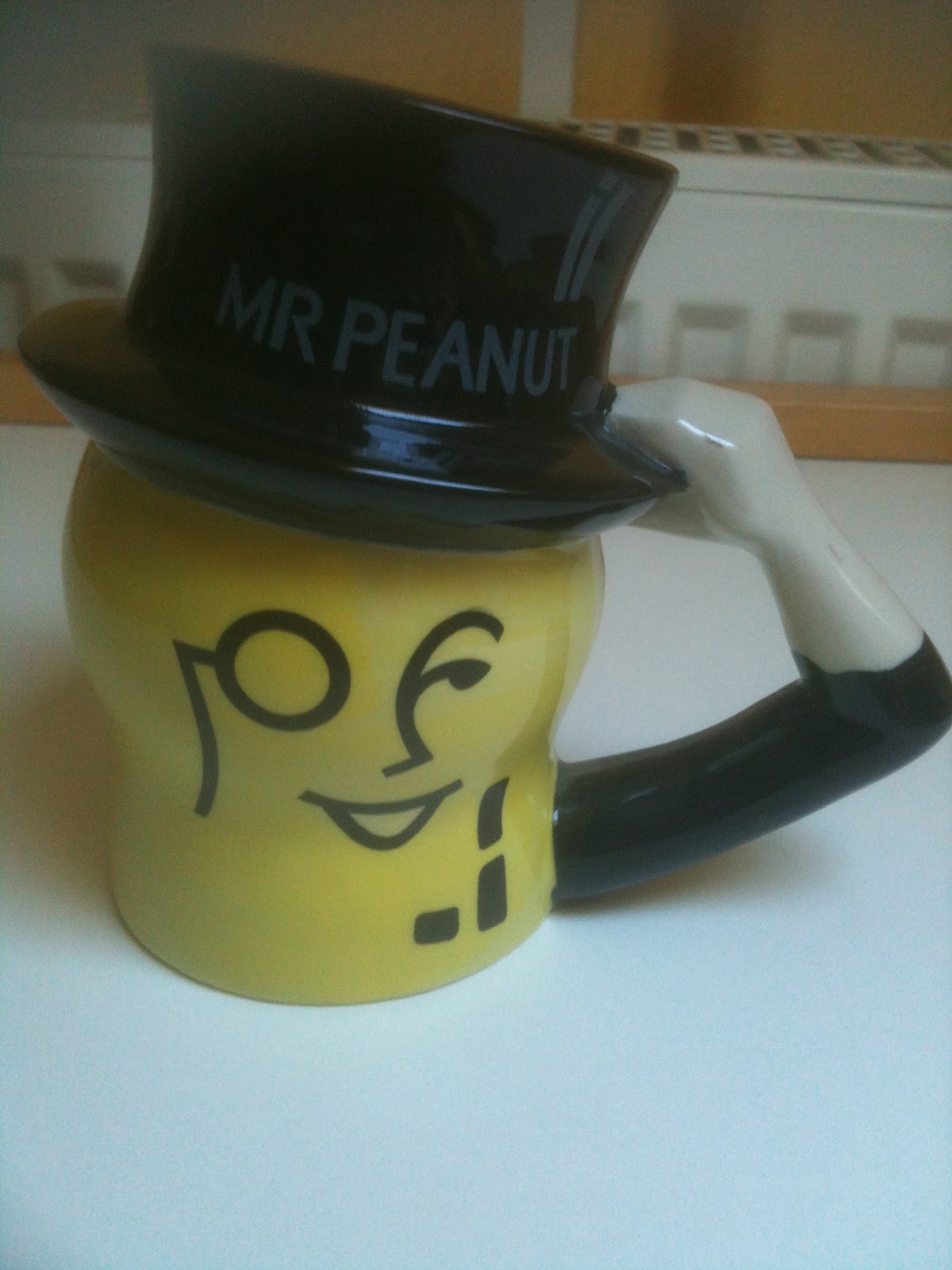
I'm not sure what year my Mr Peanut mug dates from, but it could as well have been made yesterday.
The history of Mr Peanut is fascinating. In an early example of crowd-sourcing, the original sketches won a competition for 13-year-old Antonio 'Tony' Gentile. Tony won $5 for his idea, which must have been a fair amount of money for a young teenager in 1916. Here's one of his sketches, and you can see the others and read more here.
There's a rather sad end to Tony's story. He didn't go into the world of Madison Avenue, but qualified in medicine and became a surgeon. He died of a heart attack at the tragically early age of 36.
I do wonder, though, what that young boy would have thought if he'd caught a fast-forward glimpse of his creation in 2016.
I've never been too sure about the use of the word 'archetype' in a marketing context. As a psychologist, my association with the word is Jungian, and something far more complex than which box you end up in in a Buzzfeed - style quiz.
OK, reservations aside, I do admit that sometimes a 'typology' exercise can be useful in brand positioning work. It's more than just a description of a personality - it can help describe how people relate to your brand, and maybe gives a tone of voice for the brand communication. In a crowded market it's a way of distinguishing between brands.
I was intrigued to see the 49 Personality Archetypes developed by the How to Fascinateconsultancy, led by Sally Hogshead. The consultancy is mainly in the business of personal branding, but of course brand managers also want their brands to fascinate! Sally Hogshead has a background as an advertising copywriter, and has defined '7 Advantages of Fascination' - Innovation, Passion, Power, Prestige, Trust, Mystique and Alert. When these are put in a matrix, the 49 personality archetypes emerge, each with a primary advantage plus a secondary advantage, creating personas as different as The Wise Owl, The Control Freak and The People's Champion.
Similar to Myers-Briggs, you may think. But these personas are less about how you see the world and more about how the world sees you. Each has its own communications style, relationship approach and set of priorities.
I am not sure that this could be applied 100% to brands - and, of course, the questionnaire and algorithm used in the analysis are rightly proprietary, but nevertheless, it's a potentially interesting new way of looking at brands.
When I was little, I wanted to be a spy. I got off to a good start, studying Psychology at Trinity College, Cambridge but somehow got side-tracked into the wonderful world of advertising and marketing.
My children's books:
http://www.burmeon.com






 Posts
Posts