Showing posts with label 1990s. Show all posts

Monday, 24 February 2025

BREXILE: The Light at the end of the Chunnel


More reanimated scribblings from me on the subject of belonging (or not). I wrote this in June 2017, reflecting back 21 years to June 1996 and that football match.

Even June 2017 seems a distant world now - “Germany - under the chancellorship of Angela Merkel - is being hailed as leader of the free world.” Well, there’s not much hailing of that sort going on at the moment ...

-----

THE LIGHT AT THE END OF THE CHUNNEL


21 years ago, I sat down in a cellar in Mittelbuchen and wept. 


And then I got up and demanded a taxi to take me to the airport, to go home, back to England. This, of course, was absurd. I was plastered and was expected at 9 o’clock sharp in a Frankfurt West End office the next day. All I had were the clothes I stood up in and a large artwork board bearing a Magic-Markered cross of St George and pictures of Gascoigne, Shearer, Sheringham et al clipped out of the newspapers.


They were oblivious to my anguish, my German friends. Oblivious to my cries of how England had deserved to win, needed to win, for the good of the whole country. The tragic irony of it all. Beaten at Wembley – the hosts! It just wasn’t cricket. 30 years of hurt. Hurt to the bone, and what’s bred therein. It was like finding your new spouse cheating on your honeymoon.  


In March 1996, three months previously, I’d jumped the great ship Britannia as she sailed towards the island of Cool. My one-way ticket cut through the Heathrow fog like a landing light. Terminal 1 echoed with finality – no going back?


Who in their right mind would want to go there? We had Oasis, the Spice Girls, two World Wars and one Word Cup. They had bad haircuts and even worse music. I arrived at Frankfurt airport with the baggage of ignorant superiority and (relative) youthful arrogance. And a yuppie hangover.


Last night, 27th June 2017, was the half-final of the Under 21s. England vs. Germany, and history seemed to be repeating itself, although none of the players on the pitch had even been born, that fateful night in Wembley. Maybe their mothers had wept, as I had, clutched their bumps, and dreamed of their little man growing up to be the saviour of English football, a young lion. Or maybe not.


Has nothing changed? Maybe not on the football pitch, but there’s a world beyond that. In that world, Germany seems to have achieved a feat even more remarkable than an English football team winning on penalties. Germany – under the chancellorship of Angela Merkel – is being hailed as the leader of the free world. This isn’t about economy, or defence but about values. Who can’t fail to be delighted seeing Angie’s scornful glances and wry smiles in the presence of Donald Trump? 


Meanwhile: Oh! England, my hamster heart.


The great ship Britannia sank unceremoniously amid illegal wars, lies, cheating, fraud, bad banks, dissent, phone hacking, unscrupulous journalists and I could go on but it’s just depressing. The country is a stirred-up wasps’ nest. Full of sound and fury and signifying I’m not sure what. People have forgotten how to be human.


Am I a patriot? I don’t really know. All I can say at the moment is that I love my country for what it was and what it could be, rather than what it is today.


So, what about the football? Did history repeat itself for me too? Well, this time, no. There were no tears on my part and no alcohol. Maybe the two were connected.


The only barriers between me and getting my German citizenship now are time and money. I’ve passed the tests, gathered all the documentation and all I need do now is make an appointment and hand over my Euros.


I read an article pertinent to my situation, the other day:

https://www.theschooloflife.com/article/countries-for-losers-countries-for-winners/


The idea is that there are countries that reward winners richly, but where the losers pay the price. Yes, guess which country is top, followed by – yup, got it! And this all works because many people naturally assume that they’ll win at some point.


Germany is on the other list of countries – those where voters graciously admit they are and will remain losers and where public transport, housing and schools are fit and decent for the majority of the population: the ‘losers.’


I do wonder if my wish to become German has something to do with my middle-aged but happy acceptance that I’m not one of life’s ultimate winners?


So, German citizenship, here I come. Watch this space.


But I would like to see those bastards once, just once, lose at football! 

-----

These days, I’m clutching both passports as I scurry back and forth across the Chunnel. 

And soon we’ll get a new government here. Let’s see.

Whatever happens, and politics aside, as far as I'm concerned, There’ll Always Be a Europe. 

Friday, 1 March 2024

RETROWURST: Ten years in Germany March 2006


My latest delve around the Extrawurst archives has made me feel uncharacteristically glum. For this month’s Retrowurst was a personal reflection on how life in Germany had changed in the ten years since my touchdown one chilly March morning at Frankfurt airport, in 1996.

Partly because optimism was my default setting in 2006 and partly because those days really were more hopeful than the current grim era, this article makes me yearn for those days gone by. I characterised the changes I observed as Germany moving from its rigid, rulebound, stuffy character to something more flexible, changeable and fluid. 

Shops were opening up on Saturday afternoons and evenings! 

Women were on the up, even mums in the workplace, with Angela Merkel and the “extraordinary” Ursula von der Leyen in charge! 

A vibrant, southeast-Europe-influenced youth culture, galaxies away from the 80s USA-influenced dull rockstar stuff was thriving!

And that’s not all!

--------------------------------

Around about now – I can’t remember the exact date as I’m not yet that German – is the tenth anniversary of my arrival in Germany. Seeing that there seems to be an overkill of anniversary-celebrating in advertising here these days (this is the “can’t-think-of-a-better-idea-so-let’s-use-our-31st-anniversary-and-some-funny-nostalgia-footage-from-the-70s” school of advertising) I thought I’d join in, be a little self-indulgent and let you know what I see as the biggest change factors in Germany since I’ve been living here.


Overall, I suppose it can be summed-up that the Germans are being dragged kicking and screaming away from their rigidity, their rules and their solidity to a more flexible, changeable, fluid way of living. Of course, the rules and rigidity are still there (someone from the local Ordnungsamt could apparently come around at any time and ask us to dig up our laurel hedge because it’s not a plant local to Germany – just let them try that and I’ll give them what-for about flora racism!) but there have been some encouraging signs that things are becoming a little less stiff and stuffy.


From my own point of few, one of the biggest changes that symbolise this relaxation in attitude is the change in opening times for shops. When I first came here, everything shut on Saturday at 1 o’clock except for one Saturday in the month when shops shut at 4 o’clock. To be honest, I could never be bothered remembering which Saturday it was and always braved the crowds of formidable Hausfrauen in a sleepy haze every Saturday morning. The only places where there was an exception to this rule were petrol stations, where one could buy emergency items – I remember being viewed with complete disdain as I bought a packet of rice at five-thirty on a Saturday afternoon – or the kiosks where one can buy beer, cigarettes, newspapers and rather nasty wine. Needless to say, these have a rather dubious clientele, and you wouldn’t want to be spotted by your boss buying a couple of bottles of beer from one: it would send out all the wrong signals! 


Weekday evenings were also not much better, with most shops closing at six, so you’d often have to rush out of work shortly before six, brave the queues, then dash back in to do another hour or two. Gradually, though things have changed. It’s now perfectly possible to buy food and drink until 8 in the evening without being made to feel like a social inadequate and although Sunday opening still seems a long way off, life is a lot less stressed.


Maybe now that they’ve been released from queuing at the Tengelmann checkouts on Saturday mornings and have more time to do something useful and interesting could be one reason that women are (at last!) on the “up” in Germany. I can always remember how completely amazed I was when I arrived here of the conservative, chauvinistic attitude of traditional Germany towards women. I think that, from the outside, one imagines that Germany is a typical modern “Northern European” country, maybe a bit like the Scandinavian countries, in terms of its attitude to women. But my own experiences and those of friends continually proved this otherwise. Young women in Germany are perhaps lulled into a false sense of security: opportunities really are equal in terms of higher education where as many young women are at university as young men. In fact, the men are a little bit “behind” at this stage as the National or Social Service (one year to eighteen months at age 19) is only compulsory for men. And opportunities on the lower rungs of the career ladder seem to be quite fairly spread, too. But it is once women have children that the problems start.


It is an alarming statistic that only half of women born in Germany in 1960 with a higher academic qualification have children. Children are still viewed as a career-killer for women: companies simply do not offer opportunities for senior women executives to combine family and career, childcare is inadequate and the school-system is still based on half-days where the children from 6-19 finish at noon without lunch.


However, with Angela Merkel in power, together with her Minister for Family, Seniors, Women and Youth, the extraordinary Ursula von der Leyen (a doctor, very photogenic, seven children!), the groundswell of opinion seems to be changing. Injustice in the workplace is becoming a topic of public debate and there seem to be real efforts to drag Germany out of the 1950s (and before) in terms of attitudes to and provision for working mothers.


Talking of Angela Merkel brings me on to the next point. Not only is Angie female, but she is also from the former DDR which is a bit of a double whammy. When I first arrived here, the “East” were still very much the poor relatives and somewhat resented. Former West Germans grumbled about the amount of money they were shelling out to the East in taxes and the former East Germans – “Ossies” – were regarded very much as figures of fun: somewhat naïve characters with dreadful fashion sense left over from the 1980s and music taste to match. A few years later, around the early noughties, there was an acceptance that the “Ossies” were here to stay and wave of Ostalgie or “Eastalgia” swept the country with T-shirts sporting logos of former DDR brands, the revival of many “cult” brands and websites devoted to the whole era. Cities such as Dresden and Leipzig were actively pushed not just as tourist destinations but also as potential hosts for forthcoming events.


These days, however, the difference, such as it was, is hardly noticed. The roads in former East Germany are every bit as good as those in the West (thanks to all those taxes, presumably) and in events like the national song contest (a bit of homage to Eurovision) it’s hard to say whether the Neu or Altbundesländer are more innovative and cutting edge when it comes to music and fashion.


On the subject of fashion – not that I’m an expert on youth culture anywhere at my age – it does certainly seem that the influence of the US on young people here has waned. While certain US-originated styles do seem to have an influence, the youth here take those styles and customise them locally. One good example is Hip-Hop which is more often heard here in the German language on the radio than in the original. Interestingly, it seems to be Southeast Europe that has an increasing influence on German youth culture. With large immigrant populations from former Yugoslavia, Romania, Albania and of course Turkey, German middle-class youth has real life “ghettoes and gangsters” in the neighbourhood with plenty of language and dress codes with which to shock traditional parents.


While the kids are getting nicely integrated into Southeast European ways, the rest of the population seems largely happy with closer ties within Europe as a whole. While there was plenty of grumbling about the Euro and how everything had been marked up (ooh, it’s just the same in Euros as in Marks – no pun intended) for the first couple of years, one has the feeling now that people are beginning to see the benefits. It certainly seems to have eased traveling within other Euro countries for many people: driving through Europe these days you hardly notice the borders and you often find yourself asking what country you’re in!


The common currency and a few common “enemies” – not least the war-mongering politicians of certain nations - do seem to have united the people of Germany closer with their immediate neighbours. There is a definite feeling of Camaraderie or I suppose I should say Bruderschaft around, especially in places like the Ryan Air airports. The cheap air travel has also contributed to this Eurocentricity, and popping off to Jerez, Montpelier or Milan for the weekend has become as affordable as taking the family to the nasty theme park half an hour down the road. 


These are just some of the signs I’ve seen over the last ten years of Germany losing its stuffiness and rigidity. I’m sure there are many others and I’ll keep my eyes and ears open too over the next ten years.

-------------------------------

Well, 18 years on, I am German. The shops are still firmly shut on Sundays and Segmüller still runs dire 131st anniversary radio ads. Some things carried on getting better, such as the lot of working mums, but sadly, too late for me. 

National Service has been abolished, but how long before it’s revived in the current war-ridden mess?

What’s of concern is that some things seem to be going backwards - or rather towards a new and different form of stiffness, rigidity and lack of openness. One rule book has been torn up, but there’s a weird new one in place, written by fear. The former East German states are strongholds for the AfD and other extremists of various shades.

And a thousand and one articles about Germany - The Sick Man of Europe. The less I say about Ursula von der Leyen, the better.

Maybe the answer is to dig out my 2006-tinted glasses and philosophise that perhaps a step or two backwards is inevitably the way forward.


Tuesday, 27 December 2022

We weren’t so bad


As yet another year draws to a close, I have to admit that I’ve been having some angsty, existential pangs in a “and what have you done?” sort of mode. Not in a full-on George Bailey-James Stewart manner, but irritating twinges, nonetheless.

What am I still doing in this business, at my age?

Couldn’t I have put my education and talents to better use?

Why am I just a touch ashamed to admit, these days, that my working life has been spent in advertising?

Thirty years ago, in London, every taxi driver knew the name Saatchi & Saatchi. Respondents in group discussions regularly joked about enjoying the ads more than the programmes. Our agency hired Alexandra Palace for the Christmas party - and I nonchalently flew off to LA the next day on three hours’ sleep for client product experience with British Airways.

It’s fashionable to regard advertising as a rather sorry, grubby little business these days. The glamour has passed its sell-by date and attempts are made to elevate it from the snake-oil salesman via association with super-scientific data-driven rigour or a holier-than-thou world-saving loftiness. The rot set in already in the 1990s when Kevin Roberts proclaimed Saatchis to be an “Ideas Company” rather than an advertising agency. 

But now and again, I read an article which warms the cockles of my old ad woman’s heart. And I’ll end my blog posts for this year with this marvellous article by Tom Roach . Although the main theme is the much-hyped imminent death of advertising, the underlying message is that maybe those working in the business could be a touch prouder of what they do. 

How the advertising industry uses the power of human imagination for commercial impact should be something we’re all in awe of.

As a measure of that commercial impact, Tom quotes a Deloitte study which estimates that every $1 spent on ads generates $6 in broader economic impact. Not bad for a grubby little industry - one of the few true proven levers of growth.

The role we play in driving the economy, and therefore society, forward is something we should be proud of. We often highlight advertising’s societal impact when talking about social purpose, but advertising’s economic impact alone should be a sufficient source of pride.

Well, maybe if you put it like that ... I may hang on in here for a while yet!


Wednesday, 14 December 2022

From Accenture to Zukunftsinstitut


Here we go again - it’s that time of year, when all the futurologists and trend forecasters and other shades of seers and sages get those reports out on what we might expect for 2023. There used to be a manageable handful of these, but now every agency worth its salt and pepper wants to have a go. Thankfully, these days, there are bright and helpful people who curate these things, or at least bundle them altogether on one convenient link. This collection, for example, is put together by a group of six strategists, plus various collaborators across Europe and Asia. They started their good work during Covid and have compiled the trend reports since 2020.

I hope I’ll get a chance when things calm down a bit to look at some of the better of these reports. But at the moment, it makes me weary just opening the thing up. There are 76 prediction-type reports and then, on top, 25 round-ups of the last year. Where to start? It’s at this point that I start to see the attractions of AI to plough through this lot and pull out the mega-ultra-über-meta trends.

Was it easier in days of yore? Well, maybe, as trend-forecasting was confined to the printed page - reports you’d pay for, articles in the better journals - and books. Queen of it all was Faith Popcorn (still popping around), and I’ve got here the 16 trends outlined in Clicking in 1996 - twenty-six years ago, before GenZ were born. ’Scuse the shaky technology:


Look at the first three. You’d be forgiven for thinking this was published yesterday, or at least some time once we’d got the worst of the pandemic behind us. Oooh. Virtual Reality! What’s that, then? Sounds new-fangled. Not that Metaverse business, is it? Where you can go on a Fantasy Clash of Clans Adventure from the comfort of your own Cocoon? What century is this, anyway?


And so it goes. Yes, it’s got a middle-class US bias, but ... “stressed-out”, “affordable luxuries”, “spiritual roots”, “personal statements”, “caring and sharing”, “warmly embraces the freedom of being an individual”, “busy, high-tech lives”, “simpler way of living”, “better quality of life”, “angry consumer - pressure, protest and politics”, “icon toppling”, “endangered planet, social conscience, ethics, passion and compassion” ...

One reason that Ms Popcorn’s predictions stand the test of time is that there is precious little mention of specific technology. The focus is not on what we’ll be doing, or how, but on the “why?” - the human motivations behind all this. 

Amid the change- and doommongers' obsession with the disruptive, VUCA, every-changing world, the panics, urgency and desperation, the conviction that things will never be the same again, it’s quite reassuring to pick up a paperback from the last century and realise that the summary of those 76 reports was languishing on your bookshelf all along. 


Friday, 11 March 2022

Reinventing the past


My dad used to annoy me something rotten when we were watching something like Colditz or The Great Escape by pointing out inaccuracies in anything from the pilots not wearing masks through to how many stripes a colonel should or shouldn’t have on their uniform.

Now that I’ve reached a certain age, I find myself doing exactly the same when it comes to advertising. When some bright spark starts talking about how such and such a campaign has revolutionalised, disrupted or utterly transformed the category’s communication, it’s usually to be taken with a pinch of salt.

Yes, I know - people want simple stories of from:to, of heroes turning things on their heads, of creatives taking humungous leaps. Short attention span and all that. The vogue for storytelling has a lot to answer for.

Still, it’s sometimes worth putting the record straight.

Recently, in Campaign, I read an article from a chief strategy officer from a major international agency praising Persil’s Dirt is Good campaign. Now, I also admire this campaign, despite its occasional forays into false directions. The campaign has been running for 17 years, which is pretty good going. The chief strategy officer makes plenty of good points about the campaign, yet dismisses all pre-2005 detergent advertising with a sweeping generalisation:

"Historically, the casting and scenarios for washing powder ads were dreadfully homogenous, typically oppressive portrayals of perfect Stepford mums beaming at a neat stack of clean clothing.

I wonder if he ever saw this Ariel ad from 1997 as a lad? Can you spot any of these:

    - Mums perfect kitchen?

    - perfectly folded piles of clothing?

    - oppression?

    - Stepford mums?

No, me neither. All I can see is a brilliant piece of communication, based on a universal human truth: the younger generation think they invented the world.

Sigh.


Wednesday, 24 March 2021

Dream-Pedlary


During the first wave of the pandemic, advertisers from retailers to telecoms, food to insurance, appeared to all have received the same script for their TV commercials, which was executed in a remarkably similar fashion worldwide: plinky piano music, an "empathetic" yet rather sombre tone, vignettes of human despair and hope, and a promise of "being there for you.

Meanwhile, on social media, people created and shared their own entertainment: OK, there were plenty of mawkish poems, but much inventive and fun stuff too - horse-riding and mountain-climbing illusions created within the confines of a small apartment, toilet-paper jokes a-plenty and song parodies that most of us still have stuck in their heads. Which seems unlikely for any of those "we're here for you" ads, let alone whichever brands they were attached to.

Those few weeks really brought into focus the challenge facing the advertising industry today, which Paul Feldwick examines in his latest book, "Why does the pedlar sing?". Advertising is less liked and less effective than it was a decade or two ago. 

While many of those in the industry may put the blame at the door of the client, for not being brave enough to buy their edgy, disruptive ideas, Paul Feldwick asks the question: what is good advertising, actually? Is it the bold, kick-ass, "stuff that matters" that's celebrated on LinkedIn and at awards ceremonies?

The answer to this question is drawn from Paul Feldwick's previous book, "The Anatomy of Humbug" as well as a fascinating look back to the origins of modern advertising, 20th century examples from his own experience, and recent studies/works from Binet & Field, Orlando Wood and Byron Sharp: good advertising is popular, something people like and something that makes brands famous.

The book is full of good advice on how to develop - and even create - better advertising. I work as a strategic planner, and I found the idea of getting away from the "essentialist" theory of brands a good wake-up call: instead of theorising about brand essences in a Platonic sort of way, get down to a direct appeal to the senses through a brand's "distinctive assets". And let the "creative process" - if it can be described as such - take its chaotic, iterative, not logically-predictable course.

The book raised questions with me, which is a good sign. Is fame (in a mass-media, mainstream sense) different for niche or local brands? And how does the call for more representation/reflection of people's lives in advertising tally with a return to the fun of the fair, the cartoon animals, the wild and wonderful, satire and general nonsense? Not to mention the much stricter regulations and guidelines imposed on the industry?

Like "The Anatomy of Humbug" before it, "Why does the pedlar sing" is engagingly-written, with a good dose of personal experience and opinion thrown in. I'd recommend it to anyone who works in brand communications and advertising.

And once lockdown is over and I can get back to the UK, I'm heading to the Museum of Brands.


Monday, 18 January 2021

Whatever happened to the inno-net?


I've remarked before how the relationship to the internet has changed over the last few decades - from the intrepid surfing and exploring of the early days, to amiable stumbling through to passive feeding. Well, of course, it was never going to stop there. The last couple of weeks have made me wonder if a better analogy for" being fed" could be "unwittingly poisoned".

And I'm also wondering if, these days, it's less Brave New World and more 1984.

In the late 90s and early 2000s, with the advent of Web 2.0, an optimistic and idealistic mood prevailed -  how wonderful that each and every member of the human race could communicate with anyone else they pleased - across and beyond borders. Could social media be the instrument of world peace?

But the realities of what human beings are actually like are now all too apparent, and the answer is: Not Bloody Likely. I'd love to know how often the word "toxic" is used in on- and offline conversations today compared to even twenty years ago.

Human beings don't like other human beings disagreeing with them. Neither do they like to be ignored.

And it's well known that nothing pleases human beings better than having their own opinions confirmed and amplified by others of a similar view. Hence the efforts built into the algorithms to keep people "inside the corral", as Bob Hoffman, the Ad Contrarian, puts it: "the algorithms feed us incrementally more lurid notions of our own dispositions." And this, of course, is in the platform's interest, to sell more advertising space.

I'm not on Twitter, but I did experience the diffusion of an online forum for writers a few years ago. The forum was run on some fairly shaky technology, and in the early days was a convivial and collegial sort of place. Of course we had differences of opinion, but we were all writers, right?

But at some point it started to go sour. A few righteous souls started stamping around and policing the place, which naturally led to individuals of a loud and rebellious nature taking a few pot shots back. Entertaining at first, but inevitably it all got rather tiresome, and writing took a second place. There were even accusations of fixing competition results - a microcosm of what's happening across the pond, if you like. Then at some point the shaky old software finally gave up the ghost.

New groups formed - a big shiny commercial one from the original hosts, as well as others created by individuals of one hue or another. It's accepted we'll never be the big happy friendly cloud crowd we were ten years ago - although maybe that was an illusion, too.

This brings me to this article by Aris Roussinos which suggests that maybe Europe needs to get out of the information and (Big) tech stranglehold as well as China's industrial and economic stranglehold. Could this be the beginning of the deglobalisation of the Internet? A European, civilisational internet?

Or maybe just civilised would be a start.


Thursday, 7 January 2021

Scale of economies


 I never studied Economics, which probably accounts for a lot - it's something I've sort of muddled through and picked up as I've gone along. We touched on socialism and capitalism as systems for how production, distribution and consumption work at school, in History, and since then I've become aware of the various variants on and hybrids of these basic models. Overall, how resources are managed and value, in terms of goods, services and quality of life is produced.

Throughout my working life, various expressions including the word "economy" have come in and out of vogue. When I started work, in the 1980s, there was a lot of talk about how we were moving from a production economy to a service economy, and as we moved into the 1990s, chatter about the information economy and the attention economy was all the rage. There's still plenty of chit-chat about the latter.

Moving on to the next millennium and, in the wake of advertising agencies re-inventing themselves, up popped the ideas economy and the experience economy. Whether "economy" was exactly the right word for these concepts, or whether "current obsession" might have been more honest, is debatable. 

In the last few years, I've been aware of the ideas of the circular economy (sensible), the gig economy (euphemism) and the purpose economy (hmmm).

What's interesting is that many of these ideas are still circulating, and I think it's yet another example of less neat and tidy "from - to" and more cumulative, with everything piling on top of each other.

My prediction for this year is for two more economies to join the merry band. There's the wellness economy for starters. I thought we'd done and dusted wellness fifteen years ago, but it's back with a Covid-propelled vengeance, fanned by the flutterings of self-care, it seems. 

And the other rising star is the identity economy (I can hear the groans from here). There's all sorts of self-improvement and personal growth gubbins attached to this one - "brand me", "being the best version of yourself" (I've often wondered - in whose eyes?), "authentic self-discovery" and "life as an identity project."

But maybe the part brands can play in the super shiny identity economy is not so new. If it's all about the question "who can X brand help me to become?",  then my thoughts go all the way back to saving up my money aged 13 to buy a Ben Sherman shirt.

Brands have always been expressions of status and identity, even if what we mean by those terms may change.


Monday, 14 December 2020

What's Swedish for Goodbye?


Last week, it was announced, amid much over-use of the word "iconic", that the IKEA Catalogue was going into retirement after 70 years' sterling service. I thought I'd take the opportunity to dig out my collection which probably isn't quite iconic, but does span four decades - and sits in an IKEA box upstairs in my IKEA-furnished office.

The first catalogue I have is from 1990:


This pre-dates my arrival in Germany, but I saw plenty of the black, deep blue and purple look for interiors in my first few years here. Check out this black leathery office:


The first catalogue that came legitimately into my postbox (I suspect I saved the 1990 deep blue horror from a clear-out at the IKEA offices at some point) was the 1997 edition - still in DM, note.


 Many items from this catalogue featured in my first flat here in Germany - and some survive, handed down to my son, who set up his first flat a year ago. Think they call that "circular economy" these days. The catalogue also featured what I think was the first PS Collection:


Bauhaus, eat your heart out! Moving into the 21st century, and the year we set up house - 2004:


I bought several items from this Kingdom of Children collection - note: no pink Princesses:


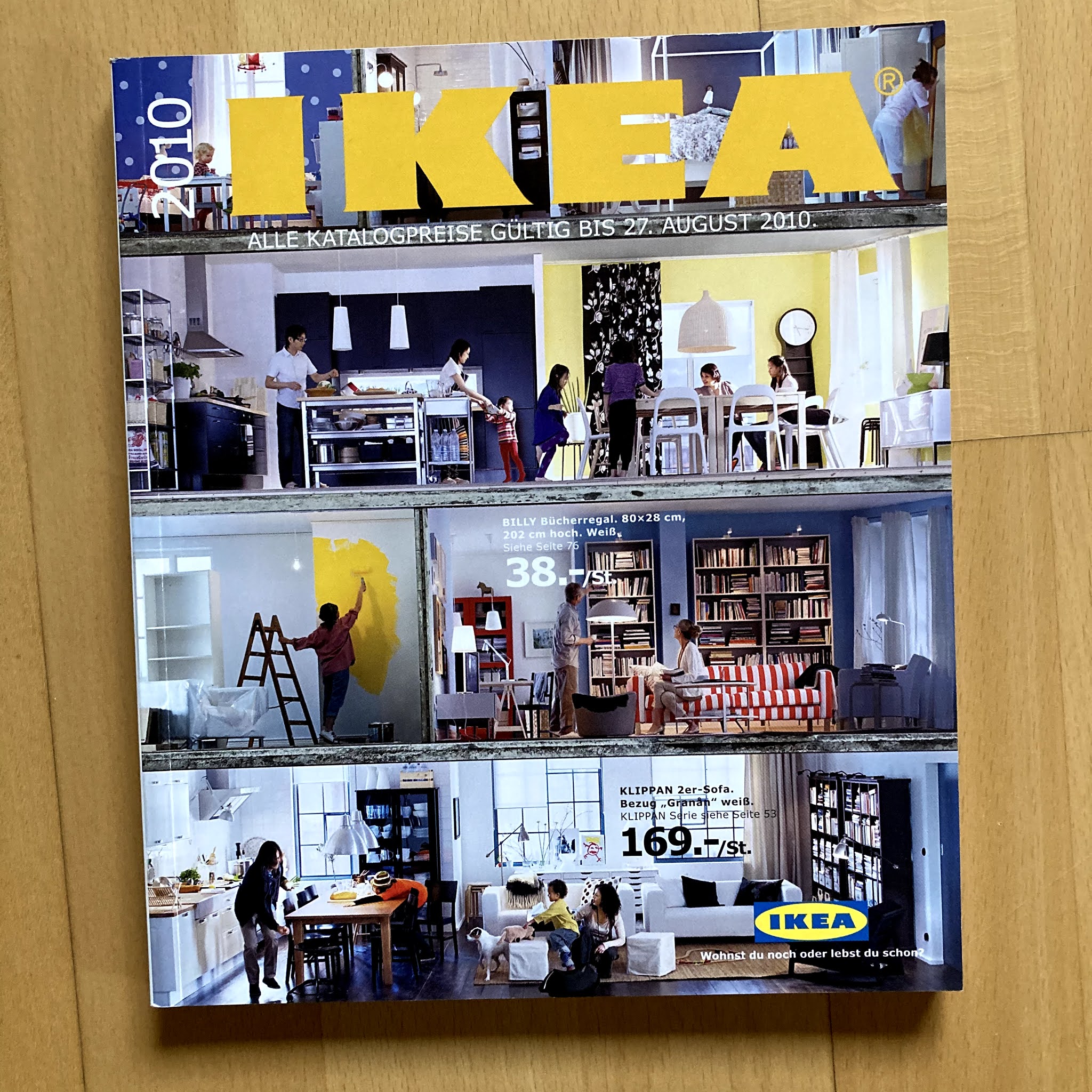
In 2010, the catalogue shrank a little in overall dimensions, but the cover took an expansive approach:


Which brings me to the latest example I have - behind the times as ever, I only have the 2020 edition, not the very last one:


I am sure there will be people who will be pleased to see the back of the IKEA catalogue. Well, here you are. Note the LACK table's decrease in price from 1997 (DM) to 2007 to 2010. 

As they say in Sweden:

 Hej då!


Monday, 6 July 2020

So long, spontaneity?

When I first came to Germany, back in 1996, one of the strangest aspects of culture shock was what I called "unspontaneous dancing". I'd been alerted to this to some extent in Austrian ski resorts, but this still couldn't prepare me for the weirdly robotic and joyless spectacle of what the Germans call Disco Fox. The low point had to be seeing a couple grimly going through the mechanical motions to Smoke on the Water. It was enough to make me want hail a taxi to the airport and hop on the first plane back.

Of course, these days, hailing taxis and hopping on planes seem like quaint memories of the past. We have all read enough articles showing how the COVID-19 crisis has accelerated trends in behaviour that were going on anyway. I commented already some years ago about the reduction of (positive) surprise in our lives, both online and offline.

It's apparent in communication and keeping in touch, where phone calls are scheduled, both business and private, and even meetings with friends are organised with the precision of a military operation - aided and abetted by all sorts of apps and software as well as both virtual and real assistants, planners, coaches and organisers.

Even before the crisis, the entire travel, hospitality and leisure industry was going this way with all-important checks on TripAdvisor, and extensive online research even for a trip to the pub. Serendipity was already on its way out of the window for many people who pooh-poohed the "real god of travellers":

All the strangeness, all the distinctiveness of a country will utterly escape you as you are led and your steps are no longer guided by the real god of travellers, chance. - Stefan Zweig, 1926 'To Travel or be Travelled'

After all, who needs strangeness? These days, "stranger" equals "danger" more than ever.

As the world emerges from lockdown, it's clear that chance should play as small a role as possible. It's a world where everything should be controlled, scheduled and traced. Safety and security have become idealised virtues: stay safe, safe spaces. Safety is what is known. Or what we think is known, that is, predictable. And we are armed with templates, frameworks, algorithms and tools to  box in, clarify and capture anything that might care to be numinous, elusive or inexplicable.

But, I wonder. While jumping on planes with gay abandon and merrily ticking off bucket-lists might become a thing of the past, maybe more conscious travel and the knowledge that things don't always go to plan may just open a door to discovering things off the beaten track?

And with social distancing the order of the day could those standardised dance moves foxtrot their way back to the 1980s and make room for something a little more inventive and expressive?


Thursday, 5 March 2020

Book binding

The notion of the customer relationship seems to be going out of fashion a little, perhaps muted by the increasing volume of "consumers don't want to have a relationship with your brand"-type clickbait headlines in marketing articles. Or maybe due to the obsessional focus on "the customer experience". But long-term experience, relationship, call it what you will is what this post is about.

Amazon is one of those brands that made a huge difference to my life. I often wonder whether it's the brand itself or the generic service of an online bookstore, but if so, Amazon was certainly the right brand in the right place for me in the late 1990s. No longer did I have to trek into Frankfurt to buy books in English. And in the early 2000s, as my son was young, Amazon was a godsend, both for the latest children's books and for tracking down old favourites from my childhood to read to him.

I started reviewing relatively late into my Amazon relationship - I've tracked down my first review, which was in May 2006. In the following 14 years, I've contributed over 300 reviews, mostly books, with the occasional CD or DVD thrown in. My reviews were always intended more for my own reference, but I was flattered when others commented on them or found them helpful. I had a brief season of fame as a Top 1000 reviewer, and was amassing 30, 40, 50, 60 helpful votes on each review on a regular basis. I felt valued, not just in terms of my custom, but also for my contribution and opinions.

It all started to go sour about six or seven years ago. Ratings, and putting a work of literature on the same level as a piece of cable or a packet of paper napkins, fake reviews, world domination, dubious business practices ... Amazon seemed far removed from the benevolent bookseller of the early days.

I carried on posting reviews, but with less enthusiasm. My Top 1000 crown had slipped, maybe because I wasn't reviewing the popular books, and maybe because I was only reviewing books, and not pieces of cable or packets of paper napkins. I started hearing reports about reviews being deleted if Amazon's algorithms detected a relationship (ha!) between the reviewer and the author.

Since October 2019, Amazon have made it official: ratings are what counts, reviews are by-the-by. And the star rating a book, or any other product, displays is not the simple average of all the ratings. Oh, no. That would be much too clear. Here's their explanation:

Amazon calculates a product’s star ratings based on a machine learned model instead of a raw data average. The model takes into account factors including the age of a rating, whether the ratings are from verified purchasers, and factors that establish reviewer trustworthiness.

Given that Amazon's ethos is about shiny new things, I seriously doubt that ratings are like wine: the age factor is, in all likelihood, a negative one. So the rating accompanying my well-thought out review in 2008 will be factored down compared to a bot giving a one-tap rating yesterday.

And most recently, I haven't even been able to post reviews on Amazon.co.uk at all, where they'd be most relevant, as I review English-language books. I can still post on Amazon.de as I spend more than I'd like to on books for my Kindle - but who is going to read my reviews there? Here's another example of Amazon making me feel like a valued customer, in their explanation as to why "this account has not met the minimum eligibility requirements to write a review":

To contribute to Community Features (for example, Customer Reviews, Customer Answers), you must have spent at least £40 on Amazon.co.uk using a valid payment card in the past 12 months. Promotional discounts don't qualify towards the £40 minimum. You do not need to meet this requirement to post Customer Questions, create or modify Profile pages, Lists, or Registries, or to read content posted by other customers.

It's not one of the world's (or even my) most pressing problems, but it does make me nostalgic for what seemed in retrospect, like a Brave New World in the mid 2000s, where anything was possible.

I'm stuck with Amazon, mainly through my Kindle. I could give up on the reviews, and go back to just doing them for myself, or on a blog, or on GoodReads. I could try and extricate myself, buy a new e-reader and start again. But it's all too much of a faff. Amazon have got me where they want me - just another customer, bound-up and too apathetic to make a fuss. 

And that's what they mean by customer-centricity.

Monday, 21 October 2019

Aufschnitt 4: How brands are changing 1999

My latest offer from the cold cuts counter is a very special one. It's not technically a cutting, because it's one of my very own charts from twenty years ago, back in the last millennium. I apologise for the way it looks - there are no fancy graphics, cute icons or co-ordinated colours. The title is everything but snappy: How Brands are Changing - Positioning Spectrum.

The idea here was that different brands take up different positions on this spectrum when communicating. Some just shout in a loud and cheerful voice that they're here while others try and press-gang you into their mission to change the world. In the middle are a whole host of functional and emotional benefits and attributes of the sort beloved by onion-builders.

My point was that a brand doesn't need to have all of this - well, it probably does, but you don't have to sit through ten hours of Post-It deluged workshops to define it all.

I'm quite begoggled that the word "experience" is there, and that what's sitting under "mission/philosophy" could quite happily pass for a description of "purpose" today.

I honestly can't remember if I made this up, or whether I pinched it from somewhere but nevertheless:

Here you go - start planning like it's 1999.

Tuesday, 4 December 2018

Sitting Pretty

We stayed in a hotel this weekend - a good, old-fashioned classic hotel, full of bygone charm. It reminded me of my first tour of Europe as a small child in the 60s, where every different country was a different country, with idiosyncratic ideas about what breakfast should consist of. Or my discovery of the "new" parts of Europe in the 1990s, gradually shaking off the dusty trappings of the communist bloc. About the only concession to modern life that that the hotel had was WiFi. Oh, and we did find it via TripAdvisor.

Now, if I'd been part of the generation where my mobile was my home-from-home, I expect I would have gone for something of a less classic nature. For example, an Ibis hotel. If you go away on holiday, you can delegate a house-sitter and dog-sitter to take care of things while you're away. And now, thanks to a campaign from Ibis by Jung von Matt/Limmat, you can also get a social-media-sitter (a "top influencer") to do all that pesky social-media curation while you enjoy yourself (if you know or remember how to).


There's a whole report from JWT Intelligence here about "Social Hotels."

Where do I start? This new generation of hotels are "encouraging meaningful connections" and "building visitors' stays around social networking." You can have a "safe, inviting and inclusive" space to meet your Bumble date at the Marriot Moxy hotel. Or "connect with vetted locals" at some other place. I hope they have all had a good dusting of flea powder.

There's also an idea to "share experience with the past and future occupants of your room." Eeek! The last thing I want to think about.

What on earth happened to wandering into the hotel bar, or better still, outside to discover for yourself what's going on?


Thursday, 11 October 2018

Five build an awfully tough-as-old-boots brand

Nothing says childhood summer to me stronger than the works of Enid Blyton, and specifically, The Famous Five. Even if they didn't start off being famous, over 75 years ago, they certainly are now. I'm not a huge fan of calling fictional characters (or authors for that matter) a "brand" - I don't know why, but the reduction of a human being (albeit a fictional one) to the level of a packet of washing powder seems demeaning. But bear with me - this is more about what brands can learn from this frightfully long-lived five-some.

The original book, Five on a Treasure Island, was published in 1942, and others in the series soon followed, accompanied by games, birthday cards, stationary and, of course, jigsaws.

(c/o www.enidblytonsociety.co.uk)

The books remain in print, and are still extremely popular, although the cover designs and illustrations have changed over the years. From the print medium, it was inevitable that the Famous 5's exploits would soon transfer onto film, and so it was, with the first feature film appearing in the 1950s, and TV series running in the 1970s and 1990s, complete with the associated annuals:


In marketing, we often talk about a brand becoming part of the culture, and a sure sign of this happening is when the jokes, parodies and T-shirts become part of the social fabric. Who, that was young in the 80s, will ever forget the Comic Strip's Five Go Mad in Dorset?

As brands get long-in-the-tooth, their managers begin to fret: are we keeping up to date? Are we still appealing to today's young generation? Is it enough to change the shorts and long socks of the original illustrations to hoodies and sweat-pants? The text of the books has been subject to a little bit of correction, some of it practical (decimal coinage) and some of it political (tweaking attitudes that are not acceptable today). 

As the Famous Five moved into the digital age, a new spin-off cartoon series was created, featuring the 5's offspring, right up-to-date with all the latest technology:


The parodies continue, and anyone that has been in a UK bookshop in the last year or so can't have failed to notice this and the others in the series:

Some brands get terribly huffy about parody and spoof. I don't know if there were any legal battles surrounding Brexit Island and Co. but as an outsider, it's easy to see how this bit of affectionate fun hardly damages the "brand" - rather, it reinforces it. I wouldn't be at all surprised if sales of the original books have taken off again since these take-offs hit the shelves.

Which all brings us nearly up to date. Where are the Famous 5 off for their next adventure? Well, in marketing terms they're doing a bit of a co-operation. Or is it a celebrity endorsement?

Mine's a meat paste sandwich with lashings of ginger beer.

Wednesday, 9 May 2018

Change happens. Get over it.

One of the core questions for marketing people has always been centred around how to adapt and transform in an ever-changing world. There's an interesting and useful analysis here by two authors from the agency Flamingo, who have examined change in a wide variety of fields, and constructed a simple model showing four strategic directions a brand could choose - Guide, Translate, Create and Pivot - along with good examples of brands who have used those different strategies.

I like this analysis, although it does tiptoe into an area that seems to be, in my mind, rather over-played currently: that of the VUCA world "out there."

There can be few readers who haven't heard about VUCA from some source or another, but in case you haven't, the acronym stands for Volatile, Uncertain, Complex and Ambiguous.

This acronym didn't come from some marketing consultant, but from the U.S. Military, in the context of Afghanistan and Iraq in the 1990s.

Is this really how we want to see the world we're operating in? Are our brands weapons in some kind of war?

I don't think so.

What if we thought of it this way:

For 'Volatile', read 'Spontaneous'

For 'Uncertain', read 'Surprising'

For 'Complex', read 'Diverse'

And for 'Ambiguous', read 'Enigmatic'

Because it's not us against them, there is no world "out there", "external" and "internal". We are all part of the world.

It's the role of brands not to provide stability in the sense of stasis and resistance to change, but rather to provide a clear purpose and direction as part of a wonderful, multi-facetted, animated, rich and mysterious world.


Wednesday, 4 April 2018

(Home-grown) Problem:Solution Advertising

Advertising in the past (especially from the likes of Procter & Gamble) frequently featured a format known as Problem - Solution. The Problem would be dramatised in a way first to get heads nodding - oh-yes-I-have-those-stubborn-stains-too-but-never-dared-mention-them. Then, in a starburst of glory, the Solution would enter the screen in a heroic pose, possibly accompanied by a man in a white coat or a super-scientific nifty demo.

Once super-hero Solution had done its job, the end benefit would be celebrated with cheesy smiles all around (particularly if the Problem was unsightly yellow stains on teeth, or similar.)

However, after a while, 'Problem Fatigue' began to set into that style of advertising. Most of the world's household stain problems, washday woes and less-than-perfect skin, hair and teeth gripes had been tackled, if not completely eradicated by the various solutions on offer. Companies started inventing problems to which they'd already made the solution. Or dilemmas which no normal person in their right mind would ever entertain. It all got a bit ludicrous.

But a few years ago, advertisers started to strike a rich seam. Problems - less physical, more attitudinal - that the advertising and marketing industry had themselves created.

Take the picture above. Back in the 80s, 90s and even early noughties, clothes and toys for young children were fairly gender-neutral. With a few notable exceptions. But for the last couple of decades, more and more sparkly pink and girl/boy-designated books, toys, birthday cards, wrapping paper  and even cakes and sweets have crept in. So, all of a sudden, there's an issue - gender stereotyping - that brands can bravely fight against. While keeping quiet about who created the problem in the first place.

Ditto Objectified Women in Advertising. There are more than a few plucky brands taking a stand against this issue. Accompanying their efforts is a narrative that suggests that back in the dark ages of the last century, almost all women in advertising looked something like this, unless they were cast into the role of mother/housewife:


And, worst of all, women at the time meekly accepted their lot of how they were portrayed. Really? Maybe most of us had more important things than advertising to worry our pretty little heads about at the time.

While we're on the subject of women, there are those now well-known enemies: flawless beauty:


And stick-thin models:


Again, these 'issues' - which were manufactured by the advertising industry itself - are being used as societal problems which the new, virtuous, purpose-led brands can rush in and solve in a blaze of awards, social experiments and tear-jerking commercials.

What takes real bravery, though, is to admit to having created (or exacerbated) a real problem, like plastic waste,  or  unnecessary additives in foods and make a commitment to do something about it:


Sometimes the world of advertising, with its issues, problems and solutions, feels rather like the world of reality TV, where the winners of one ghastly show are recycled as contestants for the next.

And no-one outside the echo chamber really cares.


Wednesday, 28 March 2018

Meanwhile, down at the Old Bull & Bush ...

I've had the pleasure of working on several alcohol brands throughout my career - Courvoisier, Harvey's sherries, and Lanson champagne, to name a few. The 80s and 90s of the last century were something of a golden age for drinks advertising in the UK. Who could forget this glorious commercial?


Working on alcohol brands today is a different story. Much of the brands' budgets are taken up with promoting what's called 'responsible drinking' which must be something of a conundrum. How do you promote your brand, differentiate it but at the same time warn about not going overboard with the stuff? It's a bit devil you do, devil you don't, and I don't envy people working with this puzzle, to be honest.

If you look at the stats and that alarming rise in the early 2000s, you can see why something had to be done:


And this is what you end up with. It kind of swims or sinks depending on how much cred the artist in question has. And I must admit that I don't have a clue on that front.


There was another time in history when alcohol consumption was at alarming levels in the UK - and by all accounts easily available to children:


At the end of the 19th century and beginning of the 20th, alcohol consumption levels were even higher than 100 years later. This gave rise to movements promoting 'abstinence' and 'temperance' rather than today's phrase 'responsible drinking.' These movements were usually linked to religions and certainly not to the alcohol producers themselves.

One such was the 'Band of Hope Union' which tried to nip the habit right in the bud. This was a club for children with the aim of preventing them from starting to drink alcohol. One method was to teach youngsters about the effects of alcohol on the human body, and certificates were awarded for 'reporting a lecture on alcohol and the human body' - the one above was awarded to my grandfather while he was in his early teens.

I know my grandfather grew up to enjoy a pint or two as much as the next man, but I wonder how much of the decrease in consumption seen in the pre-WW1 years above was due to the efforts of the Temperance Societies? Behind all the drum-beating and holier-than-thou stuff, they were at least treating teens as intelligent humans with an interest in the latest scientific findings.

Today, the UK alcohol industry is quite different to the one I knew 20 years ago. There are 10,500 less pubs in the UK today than there were in the year 2000.  Here's a recent article with this and other statistics on the Brits and drinking.

I'll end, I think, with a quotation from Hilaire Belloc which makes me slightly misty-eyed:

But when you have lost your Inns, drown your empty selves, for you will have lost the last of England.